Editor's Note
On September 21, the main forum of the 2025 Pujiang Innovation Forum was held in Shanghai. Wu Huaqiang, Vice President of Tsinghua University, stated at the forum that the "Carbon Neutrality and Energy System Transformation"(CNEST) Program, initiated by Tsinghua University, has been approved for cultivation and project approval. It will join hands with many universities and large-scale energy enterprises at home and abroad to participate. The program is committed to leading the global energy revolution, guiding the construction of a new -type energy system, facilitating the global green and low-carbon transition and the realization of the vision of sustainable development. Up to now, it has attracted scientists from dozens of countries and regions to participate in it. The following is the full report of the relevant content by Science and Technology Daily.
Taking Strides Forward in Promoting Global Open Cooperation in Science and Technology
The Main Forum of the 2025 Pujiang Innovation Forum Explores Ways to Address Global Challenges
By Du Peng and Liu Yin, Reporters of Science and Technology Daily
On September 21, the main forum of the 2025 Pujiang Innovation Forum kicked off in Shanghai. Yin Hejun, Minister of Science and Technology, pointed out at the forum that President Xi Jinping has noted that scientific and technological innovation is a crucial force for humanity to jointly tackle risks and challenges, and promote peace and development. The Chinese government attaches great importance to scientific and technological innovation, firmly implements the strategies of rejuvenating the country through science and education, strengthening the nation with talents, and driving development through innovation. It enhances the full - chain deployment and full - field layout of scientific and technological innovation, comprehensively boosts scientific and technological strength and innovation capabilities, fosters and expands new quality productive forces, and provides stronger scientific and technological support for advancing Chinese-style modernization.
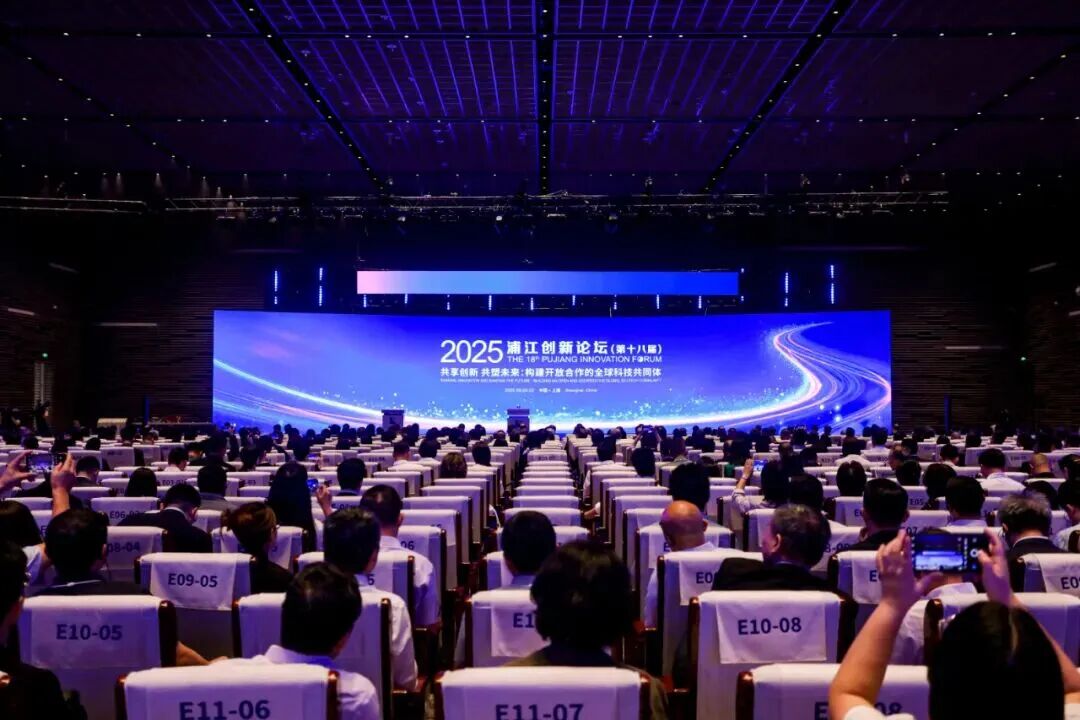
Image Source: Official Website of the Pujiang Innovation Forum
Yin Hejun emphasized that building a global science and technology community is an inherent requirement for supporting Chinese - style modernization with scientific and technological modernization, an inevitable choice for addressing global challenges, an essential need for seizing the important opportunities brought by the new round of scientific and technological revolution and industrial transformation, and a significant approach to improving global science and technology governance capabilities. China will strengthen bilateral and multilateral intergovernmental and non - governmental exchanges and cooperation in science and technology, promote the interconnection of multi - dimensional cooperation in technologies, achievements, platforms, talents and other aspects. It will deepen scientific and technological innovation cooperation under the Belt and Road Initiative, and build exchange platforms such as joint laboratories, science and technology parks, and scientific and technological innovation cooperation zones. China will accelerate the implementation of international mega - science programs and mega - science projects, and make more Chinese contributions to solving major global scientific problems. It will also actively participate in global science and technology governance, and strengthen international cooperation, exchanges and dialogues in fields such as artificial intelligence, biotechnology, clean energy and climate change.
Putting forward forward - looking insights and clarifying cooperation directions focusing on key issues of cutting - edge science and technology and innovation ecosystems were the core topics discussed by the guests at the forum.
"This is a remarkable achievement truly co - created by multiple countries. It is exciting news and will truly benefit human health." The achievement mentioned by Ulrike Protzer, Professor of the Technical University of Munich in Germany and Director of the German National Research Center for Environment and Health, at the main forum is the world's first investigational cell therapy for chronic hepatitis B infection, co - developed by research teams from Germany, Singapore and China.
Hepatitis B virus infection is one of the major global public health challenges. Chronic hepatitis B affects approximately 300 million people worldwide and is one of the primary causes of liver cirrhosis and liver cancer. Although traditional therapies can achieve clinical cure for hepatitis B, they cannot completely eliminate the virus. Eradicating chronic hepatitis B from the source has long been a shared aspiration of medical scientists worldwide.
Ulrike Protzer introduced that her team, in collaboration with scientists from multiple countries, has developed a "TCR - T cell therapy" targeting hepatitis B and liver cancer. As recently as July this year, the National Medical Products Administration of China approved the Investigational New Drug (IND) application for SCG101V, an innovative drug developed based on this technology. It is the world's first investigational cell therapy for chronic hepatitis B infection to enter Phase I/II clinical trials under a regulatory framework, providing a practical clinical solution for the "functional cure" of chronic hepatitis B and holding the promise of ending the predicament of patients having to take medication for a lifetime.
"This is a milestone in the treatment of chronic hepatitis B and even liver cancer," Ulrike Protzer stated. She believes that the successful development and implementation of this achievement demonstrate the great significance of promoting global scientific cooperation.
Zhou Jiewen, Deputy Director of the Interdisciplinary Research Center for Biology and Chemistry at the Shanghai Institute of Organic Chemistry, Chinese Academy of Sciences, and Deputy Director of the State Key Laboratory of Small Molecule Regulation of Life Processes, shares the same view. He said, "Diverse thinking is of vital importance for scientific research. From my personal experience, when I conduct experiments with foreign scientists and discover new phenomena and problems, scientists from different countries often put forward entirely different ideas and problem - solving approaches. Such diverse thinking helps us find the most effective solutions."
Zhou Jiewen holds that the Pujiang Innovation Forum serves as a significant platform for promoting exchanges, sharing and cooperation within the global science and technology community, offering practical opportunities for international cooperation and cross - border data sharing. "It would be ideal to attract foreign scientists to work in China on a long - term basis, rather than just for short - term academic exchanges. In this way, when encountering scientific research problems, we may be able to solve them simply by consulting colleagues in the same building." He suggested that China should establish more such international scientific research platforms to gather scientists from various fields, promote cross - border data sharing, facilitate transnational scientific research cooperation, and tackle scientific research problems by leveraging diverse thinking.
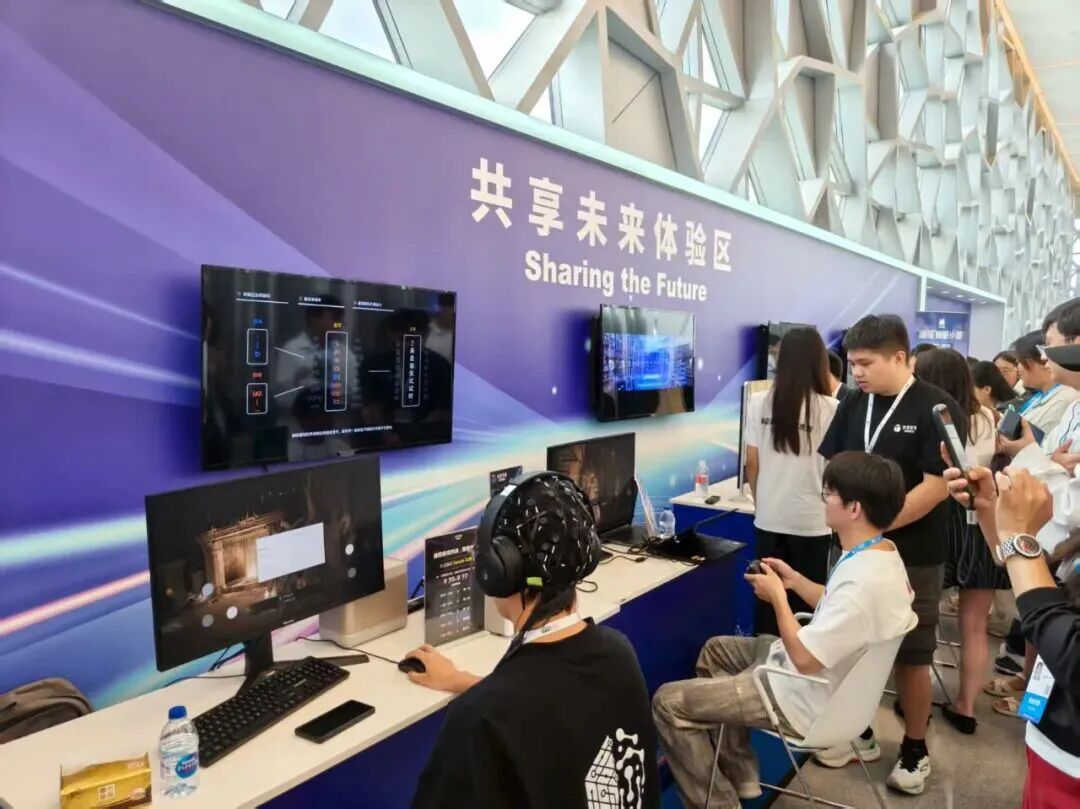
Guests attending the forum visited and experienced the exhibition area outside the forum venue. (Photo by Du Peng, Reporter of Science and Technology Daily)
China is taking a leading role in promoting international scientific and technological cooperation and building an open and cooperative global science and technology community.
Multilateral cooperation programs are important approaches to exploring the frontiers of knowledge, unlocking the unknown world and solving major global scientific problems. At present, China has deeply participated in Multilateral cooperation programs such as the International Thermonuclear Experimental Reactor (ITER) and the Square Kilometre Array (SKA). It also supports the scientific community in launching programs including the Deep-Time Digital Earth, Ocean Negative Emission, Human Proteome Navigation and International Meridian Circle.
Wu Huaqiang, Vice President of Tsinghua University, mentioned at the forum that the Multilateral cooperation program on "Carbon Neutrality and Energy System Transformation"(CNEST) , initiated by Tsinghua University, has been approved for cultivation and project approval. It will collaborate with numerous universities and large-scale energy enterprises at home and abroad. The program is dedicated to leading the global energy revolution, guiding the development of a new-type energy system, facilitating the global green and low-carbon transition and the achievement of sustainable development goals. To date, it has drawn the participation of scientists from dozens of countries and regions.
When asked "What is the top priority that global scientists should jointly strive for at present", Wu Huaqiang replied, "In today's era, I believe the most important thing is to encourage people to communicate and discuss through various means. In this way, many global challenges confronting humanity can be effectively addressed."


 Latest recommendations