On October 11, the 49th Carbon Neutrality Academic Salon on "Oil and Gas Methane Emission Reduction Technologies and Pathways" was successfully held in Beijing. This event was jointly organized by CNPC Research Institute of Safety & Environment Technology Co., Ltd. and the Tsinghua University Institute for Carbon Neutrality, with the China Clean Air Policy Partnership (CCAPP) serving as the implementing partner. The session was chaired and opened with remarks by Mr. Cui Xiangyu, a Senior Corporate Expert from CNPC Research Institute of Safety & Environment Technology Co., Ltd.
Experts and scholars from major domestic oil and gas enterprises and universities delivered thematic presentations. These included Mr. Tian Wang, Deputy Director of the HSE (Dual Carbon) Center at PipeChina Research Institute; Mr. Zou Lin, Deputy Manager of the Technical Inspection Center at Sinopec Shengli Oilfield Company; Ms. An Baojing, Senior Engineer at the CNOOC Energy Conservation, Emission Reduction and Monitoring Center; Dr. Zhang Yuzhong, Researcher at Westlake University; and Ms. Li Xiang, Senior Energy Methane Researcher at the Environmental Defense Fund Beijing Representative Office. Experts such as Mr. Yu Hang, Chief Engineer at the New Energy Research Institute of CNOOC Research Institute, were invited to provide commentary and participate in the discussions.
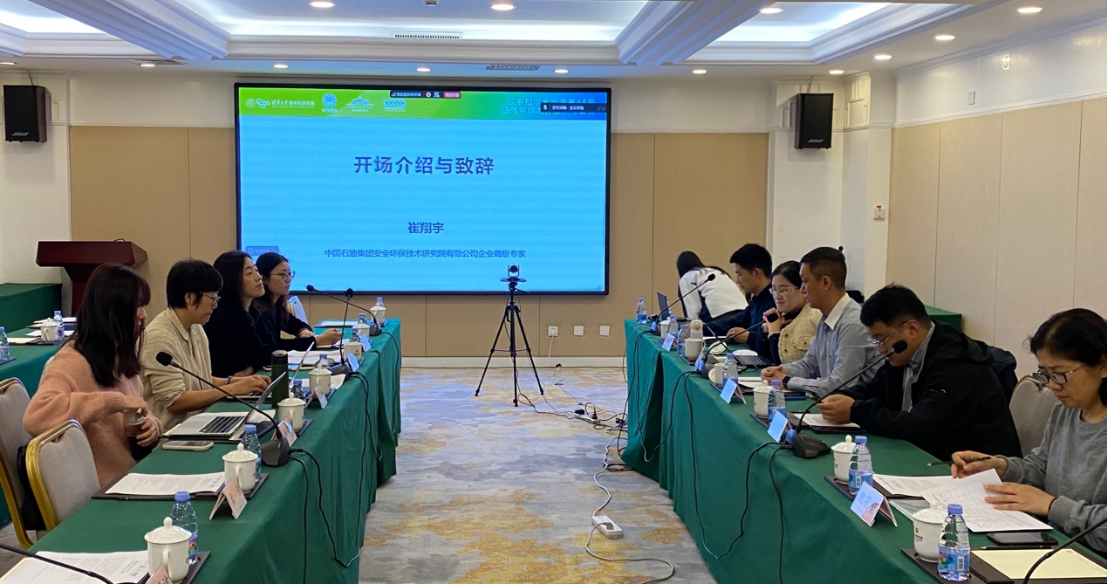
Salon Event Scene
Deputy Manager Zou Lin, in his presentation titled "Typical Application Technologies for Methane Emission Control at Sinopec," detailed the methane control pathways and technologies implemented by Sinopec. Focusing on the technical needs for closed-loop treatment processes throughout oil and gas production, he introduced best practices such as single-well closed recovery technology, closed gathering and transportation technology for single-well production units, loading and unloading emission control technology, storage tank emission control technology, and process pond emission control technology.
Senior Engineer An Baojing, presenting on "China National Offshore Oil Corporation's Methane Management Practices and Future Plans," systematically introduced CNOOC's green and low-carbon development overview, methane emission control management practices, situation analysis, and work plans. She shared insights on standard system development, industry exchange and cooperation, and methane emission monitoring and mitigation efforts. She concluded by noting that methane control has evolved from a scientific research topic to a political consensus and a focal point in international climate negotiations.
Researcher Zhang Yuzhong, in his report "Detection and Quantification of Oil and Gas Methane Emissions Based on Atmospheric Observations," began by highlighting the importance of atmospheric observations in methane emission accounting. He outlined monitoring requirements at different spatial scales, explained the characteristics and key applications of regional and point-source methane satellite observations, and introduced the latest research progress on estimating urban-scale natural gas methane emissions based on ethane observations.
Senior Researcher Li Xiang, in her presentation titled "Strengthening Measurement Fundamentals to Support Scientific Assessment and Verification of Oil and Gas Methane Emissions," opened by calling attention to the arrival of the Methane 2.0 era. Emphasizing the critical importance of accurate methane emission quantification from the perspectives of strengthening methane measurement support, conducting scientific emission assessment and verification, and leveraging financial tools to drive methane reduction, she pointed out current difficulties in assessment and verification and suggested better utilization of financial mechanisms to promote methane emission reduction.
Subsequently, participating experts engaged in commentary and discussion on the main contents of the reports, conducting in-depth exchanges on core issues facing methane management in the oil and gas industry, such as the difficulty in locating, identifying, and quantifying emissions, and the poor economic viability of utilizing medium-to-low gas volume resources. The discussion focused on the urgent need, key technologies, and reduction and utilization pathways for methane emission control in the oil and gas sector against the backdrop of carbon neutrality. A degree of consensus was reached on the orderly advancement of methane emission control in China's oil and gas industry within the context of the nation's "Dual Carbon" goals.


 Latest recommendations