The 11th installment of the Carbon Neutrality and Energy System Transformation (CNEST) Frontier Seminar was successfully convened on December 10 at the Institute for Carbon Neutrality, Tsinghua University. The session featured Heymi Bahar, Senior Analyst in the Renewable Energy Division of the International Energy Agency (IEA), who delivered a keynote lecture on the agency's flagship annual report, "Renewables 2025: Analysis and Forecasts to 2030." During the event, Professor Lu Xi, Assistant Dean of the Institute for Carbon Neutrality, presented Mr. Bahar with a commemorative plaque. Also in attendance was Mr. Ivo Walinga, Deputy Director of the IEA China Cooperation Office, while the seminar was moderated by Zhong Yijing, Director for Technology Communication at the Institute.
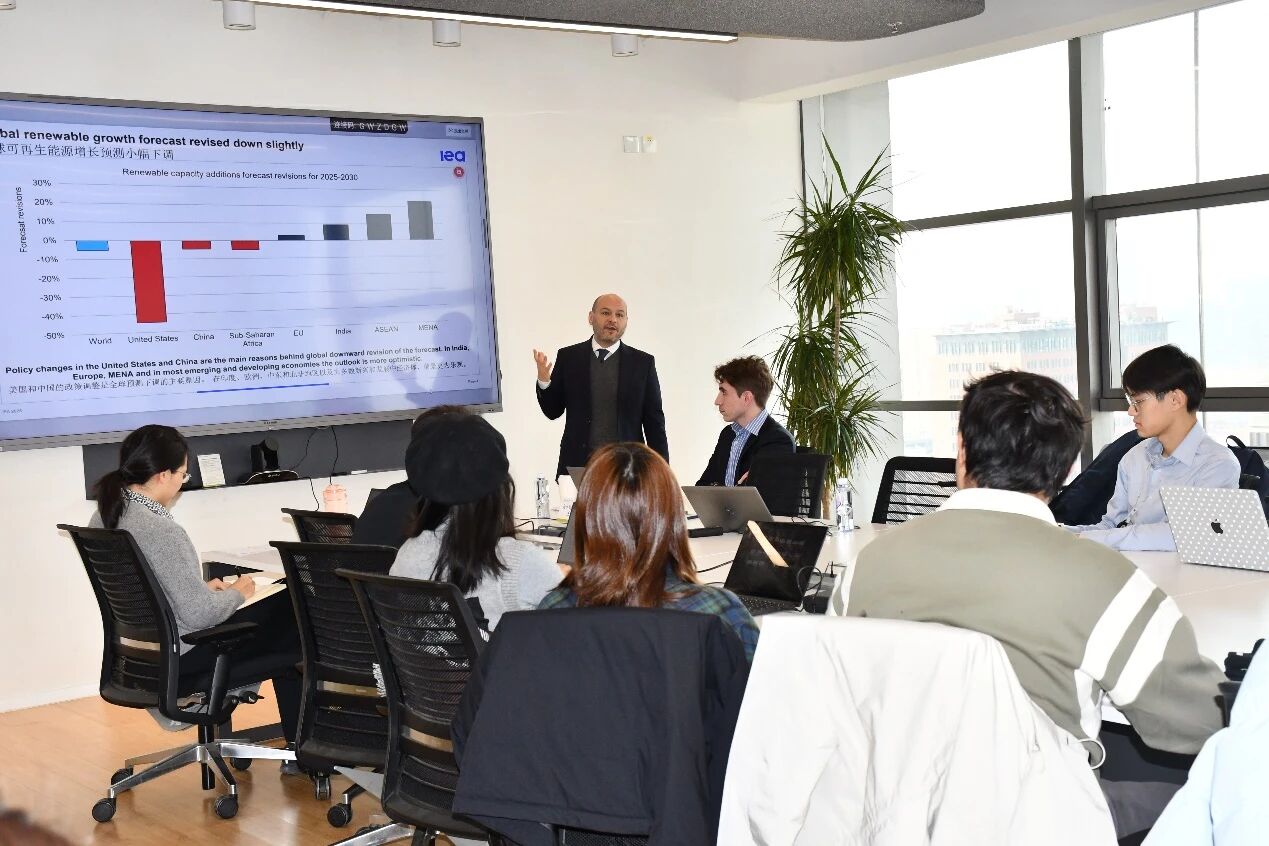
The seminar venue
In his presentation, Mr. Bahar shared the latest policy and market projections from the IEA report, which forecasts continued robust growth in global renewable energy capacity through 2030, led primarily by solar photovoltaics (PV). The report predicts that between 2025 and 2030, utility-scale and distributed PV capacity will increase by 2,050 GW and 1,500 GW respectively, accounting for 44% and 33% of all new renewable capacity, while onshore wind will add 730 GW (16%) and other technologies such as offshore wind, hydro, biomass, and geothermal will contribute another 330 GW (7%). This dominance of solar over wind is attributed to lower costs, faster approval processes, and higher social acceptance. Regionally, China is projected to remain the global leader, contributing 2,660 GW of new renewable capacity (58% of the global total) during this period, followed by the European Union (500 GW, 11%), India (350 GW, 8%), and the United States (250 GW, 5%). By 2030, China is expected to maintain its command over global PV manufacturing and installation, responsible for 60% of global installations and over 80% of production for modules, cells, wafers, and polysilicon.
However, Mr. Bahar noted that due to policy adjustments in various countries, the IEA has revised its 2030 global renewable capacity growth forecast downward by approximately 5% compared to the previous year. This includes a significant nearly 45% downgrade for the United States and a roughly 4% reduction for China. He explained that while China’s policy adjustments and power market reforms are beneficial for long-term grid integration and sustainable growth, short-term uncertainties in policy and pricing may temporarily affect the scale of new PV and wind additions. Specifically, China’s annual new renewable capacity is forecast to reach 470 GW in 2025, dip to around 400 GW annually in 2026–2027, gradually recover to about 460 GW by 2029, and exceed 500 GW in 2030. In contrast, forecasts for India, ASEAN, and the Middle East and North Africa were revised upward by approximately 10%, 16%, and 23%, respectively. Addressing trade dynamics, Mr. Bahar highlighted that protectionist policies have created difficulties for Chinese PV manufacturers, with net profits falling by about 11% in the second quarter of 2025, whereas manufacturers outside China saw profit growth exceeding 20%. Despite these challenges, an IEA survey indicates that global investor sentiment remains stable, with 39% of major developers raising their 2030 deployment targets, 52% maintaining them, and only 9% lowering them. He concluded by warning that as renewable capacity scales up, challenges related to grid integration will become increasingly prominent.
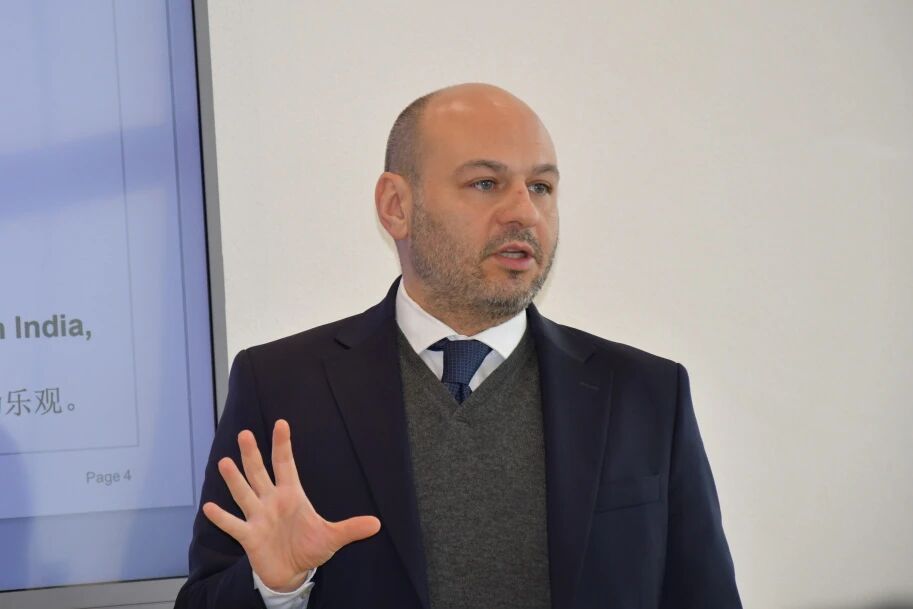
Heymi Bahar delivering his keynote report
Heymi Bahar serves as the lead author of the IEA’s Renewables report series. Prior to joining the IEA, he was a Trade Policy Analyst at the Organisation for Economic Co-operation and Development (OECD), where he analyzed national renewable energy incentive policies and their trade implications, alongside work in cross-border electricity trade and green power development. He holds degrees from Sabancı University in Turkey and Johns Hopkins University in the USA.

Professor Lu Xi engaging in discussion with the speaker
The CNEST Frontier Seminar series is organized by the Carbon Neutrality and Energy System Transformation (CNEST) multilateral collaboration program initiated by Tsinghua University and the World Carbon Neutrality Society (in preparation), and is hosted by the Institute for Carbon Neutrality at Tsinghua University. The series aims to invite renowned experts and scholars from domestic and international sectors to share cutting-edge developments in technology, industry, and policy regarding carbon neutrality and energy system transformation. Notably, the CNEST Frontier Seminars serve as a mandatory course on "Frontiers in Carbon Neutrality Technology" for doctoral students within the first-level discipline of "Carbon Neutrality System Science and Technology."


 Latest recommendations