Achieving China's "Dual Carbon" goals hinges on constructing a new energy system dominated by renewable sources. However, the inherent volatility of wind and solar power poses severe challenges to the safe and efficient operation of energy and power systems. Extensive research and practice indicate that relying solely on supply-side efforts is insufficient for the low-carbon transition. Consequently, there is an urgent need for “flexibility” on the demand side across sectors such as buildings, transportation, and industry—a requirement explicitly highlighted in key policy documents like the State Council’s Action Plan for Carbon Dioxide Peaking Before 2030.
Demand-side flexible resources (e.g., electric vehicles, HVAC systems, computing clusters) refer to terminal equipment capable of managing their own electricity consumption or generation to support grid stability. While the concept of flexibility is defined from the perspective of the energy system, it is intrinsically linked to human users. These systems provide services to people, who perceive changes and react accordingly. Traditionally, scholars in energy engineering have defined flexibility under assumptions such as “unchanged service quality” or “no impact on users,” inadvertently overlooking the inevitable trade-offs involving human comfort, productivity, convenience, and health. In other words, participating in flexible regulation incurs a “cost” that has not been clearly quantified. This gap has hindered the quantitative evaluation of flexible resource capabilities and the optimization of strategies when multiple resources interact, thereby limiting the full potential of demand-side flexibility.
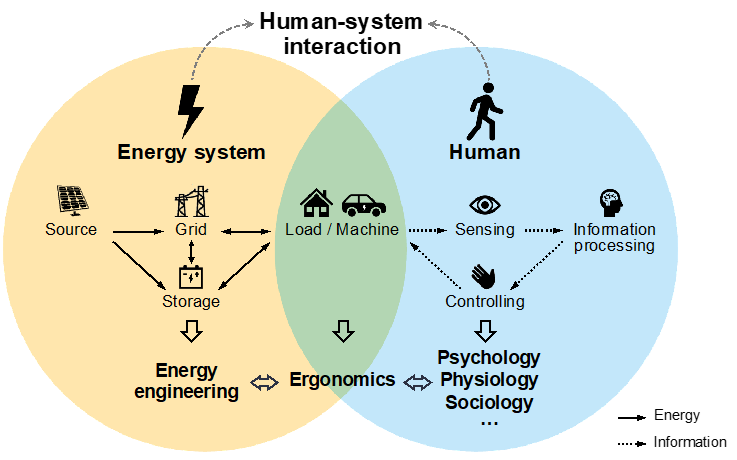
Fig. 1. “Ergonomics in Energy Use” serves as the link connecting the energy system and humans.
To address this challenge, Professor Liu Xiaohua’s team from the Zero Carbon Building Research Center at Tsinghua University's Institute for Carbon Neutrality and the School of Architecture has innovatively introduced ergonomics theories and methods into the study of demand-side flexibility. They propose a new framework titled “Ergonomics in Energy Use.” This framework marks a paradigm shift from a “system-centric” view to a “human-energy system bidirectional interaction” perspective. It aims to establish a quantitative relationship between energy system regulation demands and end-user service quality, expanding the concept of “flexibility” from a purely engineering term to an engineering-sociological one, thus offering new insights for building a “people-oriented” new energy system.
First, the study constructs a correlation between “energy use flexibility” and “service quality.” The framework links the energy system and humans through various demand-side resources. Each resource is characterized by a machine physics model, target parameters (e.g., indoor temperature, illuminance, battery SOC), and a service evaluation model. Human preference coefficients are then applied to weight their impact on overall service quality. This approach is compatible with existing experimental research and models across multiple domains, including HVAC and thermal comfort, lighting and visual environments, EV charging behavior, and data center computing demands.
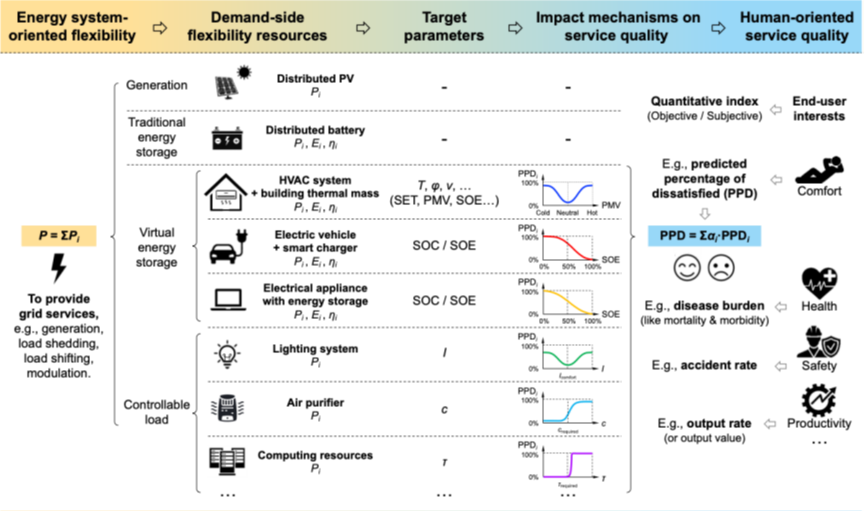
Fig. 2. The “Ergonomics in Energy Use” framework: Bridging energy system-oriented flexibility and human-oriented service quality.
Based on this framework, the team proposes a new definition for demand-side flexibility grounded in service quality: the maximum variation in energy use allowable under a specific level of service quality impact. Examples include the maximum energy savings of an HVAC system at a certain dissatisfaction rate, the maximum power adjustment of an office lighting system at a specific productivity level, or the maximum charging power reduction for EVs given a certain travel guarantee rate. This enables quantitative comparison across different resources. The study introduces the concept of “Marginal Flexibility”—identifying which resource provides the largest energy adjustment per unit of service quality impact—as a criterion for prioritizing resources in grid regulation. This establishes a method for the ordered utilization and control of multiple flexible resources.
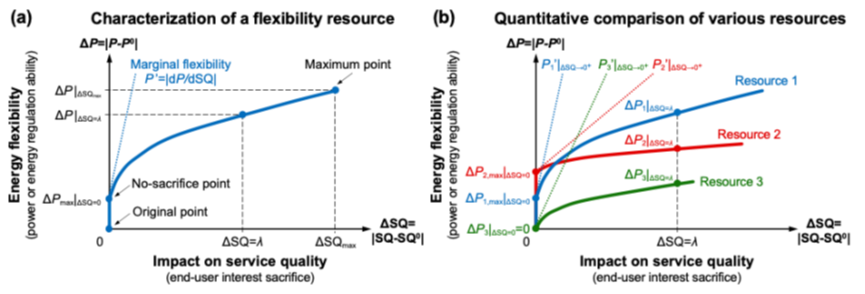
Fig. 3. New method for defining demand-side flexibility based on service quality: (a) Characterizing a single flexible resource; (b) Comparing multiple flexible resources.
The researchers demonstrated the framework’s efficacy using a 3,000-square-meter office building equipped with three typical flexible resources: an HVAC system, a lighting system, and EV charging piles. Using the Predicted Percentage of Dissatisfied (PPD) as the quantitative metric for service quality, the team analyzed optimal operating strategies under various demand response scenarios. The results showed that the framework successfully guided the three resources to achieve optimal strategies in real-time load shedding (varying start times, magnitudes, and durations) and day-ahead load scheduling, all while minimizing user dissatisfaction.
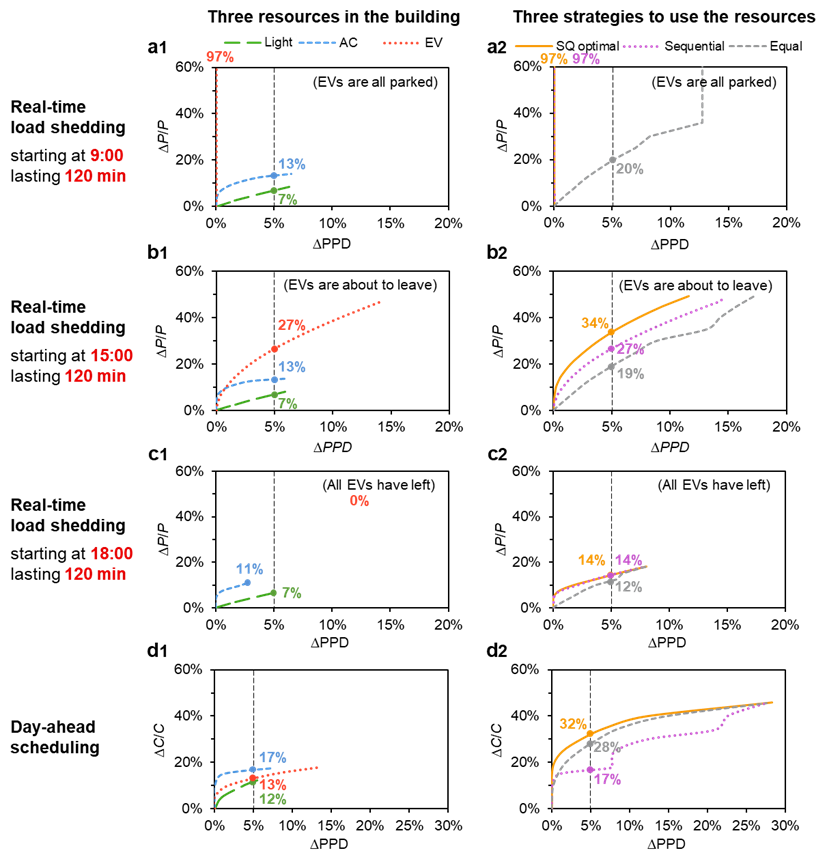
Fig. 4. Demonstration of the new definition method using an office building case study: (a) Real-time load shedding starting at 9:00 for 120 min; (b) Starting at 15:00 for 120 min; (c) Starting at 18:00 for 120 min; (d) Day-ahead load scheduling.
The study further outlines future research directions for “Ergonomics in Energy Use,” including quantifying flexibility for incentive mechanism design, developing precise characterization and advanced control methods for complex systems, understanding multi-parameter coupling mechanisms affecting service quality, and balancing the impacts of diverse resources on overall service evaluation. The authors call for interdisciplinary collaboration to tackle complex, real-world application scenarios and fully unlock the potential of demand-side flexibility.
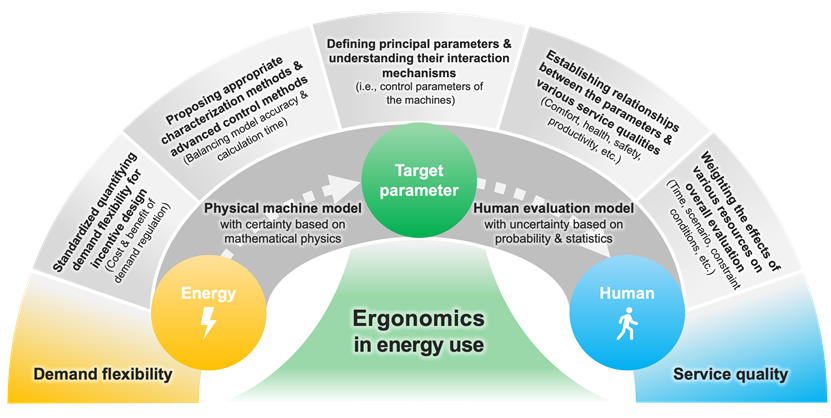
Fig. 5. Future research outlook for “Ergonomics in Energy Use.”
The findings were published on December 10, 2025, in Engineering, the journal of the Chinese Academy of Engineering, under the title “Ergonomics in Energy Use: Bridging Energy System-Oriented Flexibility and Human-Oriented Service Quality.”
Assistant Professor Liu Xiaochen from the School of Architecture at Tsinghua University is the first author, and Professor Liu Xiaohua is the corresponding author. Co-authors include Academician Jiang Yi, Associate Researcher Zhang Tao, and Ph.D. candidate Luo Ziyi. The research was supported by the National Natural Science Foundation of China and the China Association for Science and Technology’s Young Elite Scientists Sponsorship Program.
Citation:
Liu XC, Luo ZY, Zhang T, Liu XH, Jiang Y. Ergonomics in Energy Use: Bridging Energy System-Oriented Flexibility and Human-Oriented Service Quality. Engineering, 2025. DOI: 10.1016/j.eng.2025.12.002.


 Latest recommendations