Recently, a research team led by Professor Wang Shuxiao from the Joint Pollution Control and Carbon Reduction Research Center at Tsinghua University's Institute for Carbon Neutrality and the School of Environment has constructed the world's first global inventory of full-volatility organic compound emissions from wildfires. By integrating the latest wildfire emission test results, the study quantifies emissions of intermediate-volatility (IVOCs) and semi-volatile organic compounds (SVOCs), which were missing from traditional inventories. This breakthrough significantly enhances the chemical speciation resolution of wildfire organic emissions. The team systematically analyzed the contributions, volatility distributions, chemical compositions, and spatial patterns of full-volatility emissions from various vegetation types globally, while also comparing the relative contributions of wildfire sources versus anthropogenic sources. These findings provide a more scientifically robust input for global numerical simulations of secondary organic aerosols (SOA), facilitating more accurate air quality modeling, health risk assessments, and climate effect analyses. The research was selected as a Supplementary Cover Article for the journal Environmental Science & Technology (EST).
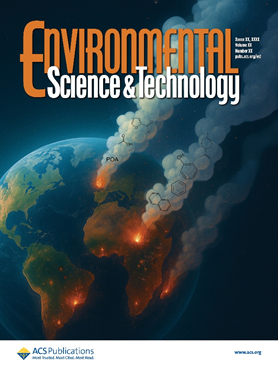
The research was selected as a Supplementary Cover Article for Environmental Science & Technology.
Every year, wildfires across forests, grasslands, and peatlands release vast amounts of organic compounds that, after long-range transport, pose widespread threats to human health. Testing indicates that these organics span a continuous volatility distribution, categorized from low to high volatility as: extremely low-volatility organic compounds (xLVOCs), semi-volatile organic compounds (SVOCs), intermediate-volatility organic compounds (IVOCs), and volatile organic compounds (VOCs). However, traditional wildfire emission inventories have historically included only particulate organic carbon (POC/OC) and VOCs, omitting a significant mass of IVOCs and SVOCs. This omission has led to substantial biases in assessing the impacts of wildfires on air pollution and public health.
To address this gap, the study integrated comprehensive test data on full-volatility organic species from wildfire sources to build an emission factor database covering OC and over 1,000 IVOC, SVOC, and VOC species. Combined with biomass burning data from the GFED4.1s database, the team achieved accurate quantification of global full-volatility organic emissions from wildfires spanning 1997 to 2023.
The characterization results reveal that traditional inventories (limited to POA + VOC) underestimated total organic emissions by 21%. In terms of vegetation types, grassland fires were identified as the dominant source, contributing 66% of global wildfire organic emissions. Spatially, Southern Africa emerged as the largest emission hotspot, with an average annual emission intensity of 4.4 tons per square kilometer.
Notably, I/S/xLVOCs accounted for 36% of total full-volatility emissions from wildfires, a proportion higher than that from anthropogenic sources (28%). Although total full-volatility organic emissions from wildfires are slightly lower than those from anthropogenic sources globally, the emissions of I/S/xLVOCs from wildfires exceed those from human activities. This finding underscores the critical role of the full-volatility framework in re-evaluating the environmental significance of wildfires.
The findings were published on December 29, 2025, in Environmental Science & Technology under the title “Global Wildland Fire Emissions of Full-Volatility Organic Compounds from 1997 to 2023.” Huang Lüyin, a Ph.D. candidate (Class of 2022) at Tsinghua University’s School of Environment, is the first author, and Professor Wang Shuxiao is the corresponding author. Co-authors include Associate Professor Zhao Bin, Assistant Researcher He Yicong, Dr. Ma Mingchen, Dr. Yin Dejia, Associate Researcher Wu Qingru from Tsinghua University, and Dr. Chang Xing from the Transport Planning and Research Institute of the Ministry of Transport.
This research was supported by the National Natural Science Foundation of China (Excellent Innovation Research Group), the National Key R&D Program of China, the Samsung Advanced Institute of Technology, and the Tsinghua University High-Performance Computing Center.


 Latest recommendations