Tropical forests, storing nearly half of the Earth's aboveground biomass carbon, are a critical component of the global carbon cycle. However, their biodiversity, carbon stock stability, and ecosystem services are increasingly threatened by human land-use activities, fires, and extreme climate events. Due to high spatial heterogeneity, diverse disturbance types, and complex recovery processes within forests, significant uncertainties have persisted in existing research regarding the dynamic changes in tropical forest carbon stocks during disturbance and recovery phases.
To address these challenges, a research team led by Associate Professor Li Wei from the Department of Earth System Science at Tsinghua University and the Center for Co-benefits of Pollution Reduction and Carbon Mitigation at the Institute for Carbon Neutrality has constructed a grid-scale database of forest disturbance and vegetation recovery based on high-resolution data. Building on this, they developed a novel forest carbon bookkeeping model that integrates high-resolution remote sensing data with their disturbance-recovery database. This model estimates the spatiotemporal dynamics of vegetation carbon stock changes caused by forest disturbances from 1990 to 2020, clarifying the specific contributions of different disturbance types and patch sizes to changes in carbon stocks and density. By introducing spatially explicit carbon pool recovery curves, the model overcomes the long-standing bottleneck of traditional bookkeeping models that rely on regional-scale response curves, significantly enhancing the ability to characterize forest spatial heterogeneity and disturbance response processes.
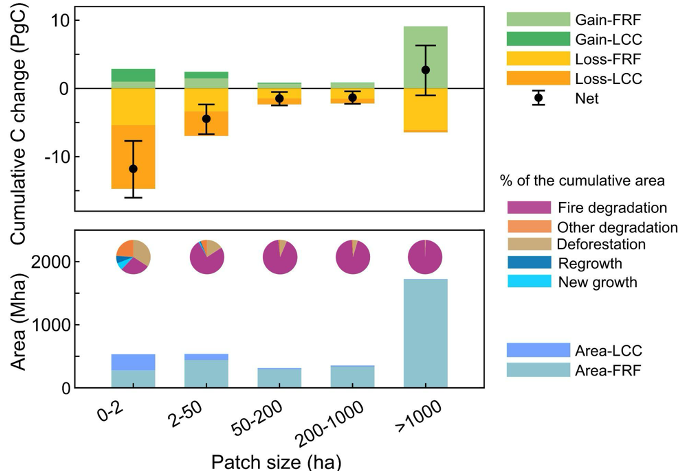
Small-scale tropical deforestation causes significant carbon losses. (Illustration showing how small patches of clearing in high-density moist forests contribute disproportionately to total carbon loss).
The study reveals that between 1990 and 2020, disturbances in tropical moist forests resulted in a biomass carbon loss of approximately 15.6 ± 3.7 Pg (petagrams). In contrast, carbon changes in tropical dry forests remained roughly balanced overall, as carbon losses from fires were partially offset by post-fire vegetation recovery. However, in moist forests, small-scale logging and degradation have led to persistent net carbon losses. Notably, while small-scale disturbances (patches smaller than 2 hectares) accounted for only 5% of the total disturbed area, they contributed to over half of the net carbon loss. These small-scale disturbances are primarily driven by human land-use changes, such as the expansion of agriculture, pastures, roads, and settlements, effectively turning affected forests into carbon sources.
Furthermore, the research highlights a troubling trend: forest disturbances are progressively encroaching from low-carbon-density edges into the higher-carbon-density interiors of forests, leading to increased carbon loss per unit of disturbed area. Although undisturbed forests continue to function as carbon sinks, their absorption capacity is insufficient to fully offset the losses from disturbed areas. While the overall aboveground vegetation carbon budget of the entire tropical forest region remained roughly balanced from 1990 to 2020, the study warns that under the dual pressures of future climate change and intensifying human activities, the carbon sink function of tropical forests faces severe threats. These findings have broad applications, including national greenhouse gas inventory compilation, carbon emission accounting, monitoring and verification of REDD+ projects, and the identification of key areas for forest conservation and restoration.
The findings were published online on January 7, 2026, in the prestigious journal Nature under the title “Small persistent humid forest clearings drive tropical forest biomass losses.”
Dr. Xu Yidi, a postdoctoral researcher at the Laboratory of Climate and Environmental Sciences (LSCE) in France and a recent Ph.D. graduate from Tsinghua University’s Department of Earth System Science, is the first author. The corresponding authors are Associate Professor Li Wei (Tsinghua University) and Professor Philippe Ciais (LSCE, France).
The study represents a major international collaboration, involving co-authors from numerous institutions worldwide, including Dr. Maurizio Santoro (Gamma Remote Sensing), Dr. Clément Bourgoin (European Commission Joint Research Centre), researchers from LSCE, Ningbo Tech University, the Aerospace Information Research Institute (CAS), GFZ German Research Centre for Geosciences, CIFOR, The Nature Conservancy, University of Toulouse, INPE (Brazil), École Normale Supérieure, and INRAE (France).
This research was supported by projects including the Science and Technology Special Project of the Southwest United Graduate School in Yunnan Province.


 Latest recommendations