Constructing a new power system dominated by renewable energy is a critical pathway to achieving carbon neutrality. As the share of fluctuating renewable energy sources like wind and solar PV rapidly increases, so does the demand for flexible regulation within the power system. Hydropower and pumped storage hydropower (PSH), with their ability to regulate power supply over time through reservoir management and their clean attributes, stand out as promising flexibility resources crucial for ensuring grid safety and stability. However, previous power system planning models have often characterized hydropower and PSH too coarsely at large spatial scales, failing to capture heterogeneity between stations or the synergistic dispatch characteristics between hydropower and PSH. This limitation has posed significant challenges to systematically evaluating the role of these resources in future power systems.
To address this gap, a research team from the Climate Governance and Carbon Finance Research Center at Tsinghua University's Institute for Carbon Neutrality and the Institute of Energy, Environment and Economy has significantly enhanced the modeling precision of their self-developed China Integrated Sustainable Power System Optimization (CISPO) model. For the first time, the team achieved station-level and 8760-hourly collaborative optimization for capacity expansion and operational dispatch of hybrid "wind-solar-hydro-storage" systems. The upgraded model also simulates cascade dispatch for hydropower and retrofitting decisions for hybrid open-loop PSH. These findings were recently published in Energy & Environmental Science (EES), a journal of the Royal Society of Chemistry (5-year Impact Factor: 35.4), under the title “Spatially resolved modeling of pumped storage and hydropower for China's carbon neutrality.” The paper’s authors include Ph.D. candidates Zhu Ziheng (first and corresponding author) and Mao Hanjie (first author), and Tenured Associate Professor Zhang Da (corresponding author) from Tsinghua University, along with collaborators Associate Professor Zhang Shuo (Tsinghua) and Assistant Professor He Xiaogang (National University of Singapore).
Utilizing high-resolution Geographic Information System (GIS) data, the team systematically evaluated China’s resource potential for hydropower and PSH. The results indicate that the economic potential for existing and potential hydropower capacity totals 715 GW, concentrated primarily in southwestern regions such as Tibet, Sichuan, and Yunnan. The economic potential for open-loop PSH is approximately 390 GW, while closed-loop PSH holds a vast potential of about 1,960 GW. Based on this data, the researchers designed four scenarios, ranging from high-precision cascade optimization and site-level planning to traditional grid-level modeling, to quantify how different modeling precision levels impact system planning outcomes.
In the baseline scenario, designed to meet an annual electricity demand of approximately 20 PWh and achieve negative emissions by 2060, the optimized system configuration includes: Hydropower 690 GW, Wind Power 2,727 GW, Solar PV 5,178 GW, Closed-loop PSH 368 GW, Open-loop PSH 205 GW, and Battery Storage 626 GW.
Under this configuration, the system's levelized cost of electricity (LCOE) is approximately 0.33 CNY/kWh, with curtailment rates for wind and solar kept at low levels.
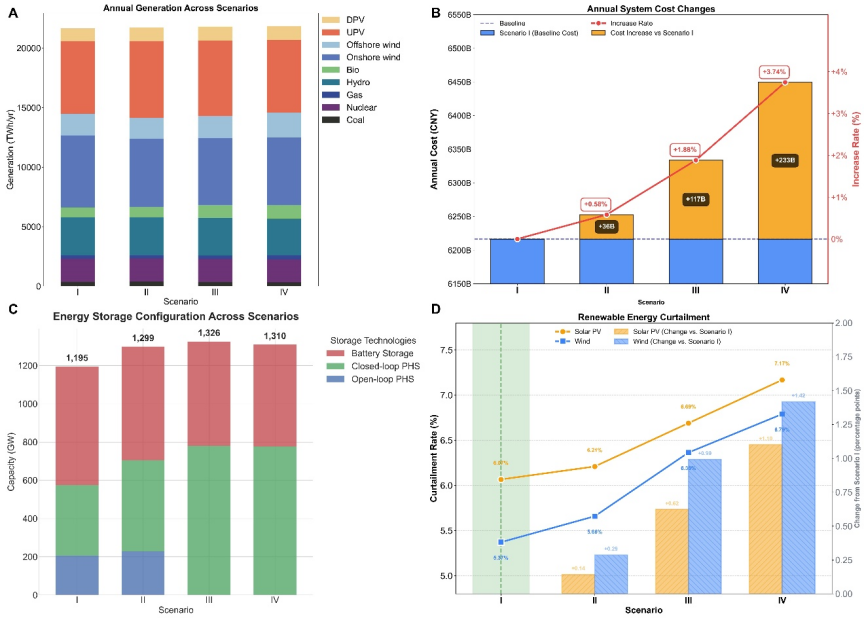
Comparison of system-level results across different modeling scenarios. (A: Annual generation mix; B: Changes in total annual system cost; C: Energy storage capacity structure; D: Changes in wind and solar curtailment rates).
The study highlights that precise characterization of PSH and cascade hydropower dispatch is vital for system economics. Deploying 205 GW of open-loop PSH could reduce annual system costs by 81 billion CNY and decrease wind and solar curtailment by 11% and 7.2%, respectively. Furthermore, nationwide cascade optimization of hydropower could save approximately 116 billion CNY annually. These savings stem primarily from enhanced system flexibility: cascade dispatch allows for greater water release during dry seasons, supporting larger-scale solar integration and reducing reliance on expensive flexibility sources.
Conversely, the study warns that modeling precision significantly affects planning results. Traditional grid-level modeling with fixed duration assumptions was found to overestimate the required capacity of closed-loop PSH by 30%, leading to unnecessary extra costs of 36 billion CNY per year.
The market outlook for PSH is promising. In a power system dominated by high shares of renewables, significant intra-day and seasonal price volatility will create ample arbitrage opportunities for PSH. The study finds that the required capacity payment subsidies for PSH stations could drop significantly to below 200 CNY/kW/year. Many stations, particularly in Northern and Central China, could become profitable solely through electricity market trading without any government subsidies. This finding offers crucial policy implications for transitioning PSH from a subsidy-dependent model to a market-driven one.
This research builds upon the team’s previously developed CISPO model, whose foundational results were published in EES in February 2025. While the original model achieved national-scale optimization at 8760-hourly resolution and 25km×25km spatial precision, this latest study further refines the modeling of hydropower and PSH to the station level, enabling high-fidelity simulation of cascade dispatch and hybrid open-loop retrofits. The findings demonstrate that refined modeling of hydro and storage flexibility is essential for accurate economic analysis of deep decarbonization in large-scale power systems. It provides a scientific basis for defining the roles of hydro and PSH in the energy transition, designing electricity market mechanisms, and coordinating cross-regional water resource management.
The study was supported by two special projects and a major project of the National Natural Science Foundation of China, the Carbon Neutrality and Energy System Transformation (CNEST) program, and the Environmental Defense Fund (EDF).


 Latest recommendations