A research team led by Professors Li Zheng and Liu Pei from the Department of Energy and Power Engineering at Tsinghua University, in collaboration with researchers from Princeton University and supported by the Low-Carbon Energy and CCUS Research Center at Tsinghua's Institute for Carbon Neutrality, has achieved a significant breakthrough in the synergistic and large-scale deployment of green hydrogen and Carbon Capture, Utilization, and Storage (CCUS) technologies. Published online on February 6 in the prestigious journal Energy & Environmental Science under the title "Scaling green hydrogen and CCUS via cement-methanol co-production in China," the study introduces and systematically validates a novel paradigm: renewable energy-driven cement-methanol co-production. By establishing a collaborative analysis framework that spans process flexibility, plant-level economics, and macro-level technology deployment, the research offers a viable pathway for optimizing infrastructure layout and promoting the joint deployment of green hydrogen and CCUS in hard-to-abate industrial sectors.
While CCUS is widely recognized as indispensable for achieving deep decarbonization in industries such as cement and methanol production, its large-scale adoption has historically been hindered by high costs, insufficient infrastructure, and uncertain market incentives. To accelerate the maturity and scalability of green hydrogen and CCUS, identifying early application scenarios that are both economically feasible and replicable is critical. Addressing this challenge, the research team proposes a synergistic pathway termed "Cement-Methanol Co-Production." This innovative model leverages high-purity oxygen, a byproduct of renewable electricity-driven water electrolysis for hydrogen production, to support oxy-fuel combustion in cement kilns and facilitate CO₂ capture. The captured CO₂ is then utilized as a carbon source for methanol synthesis, achieving a sophisticated cross-process molecular coupling of "carbon-hydrogen-oxygen."
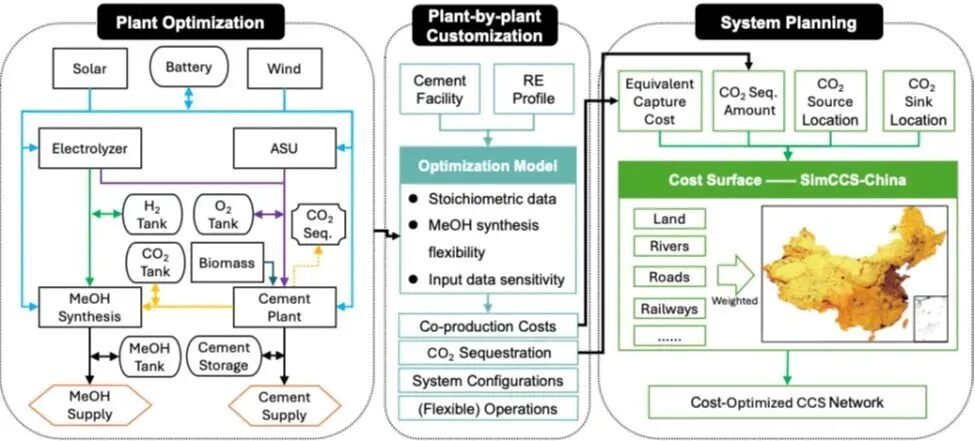
"Cement-Methanol Co-Production" Synergistic Analysis Framework Integrating Process Flexibility, Plant-Level Economics, and Macro-Scale Technology Deployment
The study's comprehensive analysis reveals that compared to pursuing cement decarbonization and renewable methanol production separately, the co-production model significantly reduces overall emission reduction costs. The findings suggest that this technology is particularly suitable for initial deployment in cement plants located in regions with abundant renewable energy resources. Furthermore, the adoption of this model could profoundly influence the spatial planning of CO₂ transportation and storage infrastructure. By demonstrating the potential of industrial symbiosis, the research highlights how cross-sectoral material flow coupling and process integration can simultaneously match"carbon sources," "hydrogen sources," "oxygen sources," and related infrastructure within a single system. This provides a new, more economical route for deep decarbonization in hard-to-abate industries, offering a scalable solution for global climate goals.
The paper's first author is He Yuezhang, a 2025 Ph.D. graduate from Tsinghua's Department of Energy and Power Engineering. The corresponding authors are Prof. Liu Pei and Prof. Li Zheng from Tsinghua University, along with Prof. Eric D. Larson and Associate Prof. Jesse Jenkins from Princeton University. The research team also includes Associate Research Scholar Hongxi Luo and Ph.D. candidate Anna Li from Princeton University; Lin Yuancheng, a 2024 Ph.D. graduate, and Wang Zhenqian, a 2023 Ph.D. candidate, from Tsinghua's Department of Energy and Power Engineering; Carl J. Talsma from Carbon Solutions in the USA; and Fang Yujuan, an Assistant Researcher at Tsinghua's Low-Carbon Energy Laboratory.
The full paper is available at https://doi.org/10.1039/D5EE07379K.


 Latest recommendations