A research team led by Professor Li Zheng from the Climate Change and Carbon Neutrality Strategy Research Center at Tsinghua University's Institute for Carbon Neutrality and the Institute for Climate Change and Sustainable Development, in collaboration with researchers from Princeton University and Saudi Aramco, has achieved a significant breakthrough in the design of renewable energy-driven hydrogen-based steelmaking systems. The study, titled "Unlocking Multi-Stage Flexibility Enables Cost-Competitive Hydrogen-Based Steelmaking in China," was published online on February 27 in the journal Energy & Environmental Science. This research systematically reveals that under conditions of high penetration of wind and solar power, cross-stage synergistic optimization across the entire "hydrogen production-iron making-steelmaking" chain can significantly reduce the cost of green steel, providing critical quantitative support for the large-scale deployment of hydrogen-based steel in China.
The steel industry accounts for approximately 7% of global carbon emissions, and hydrogen-based direct reduced iron (DRI) is widely regarded as a crucial pathway for deep decarbonization in this sector. However, the inherent volatility of renewable energy sources challenges the traditional "continuous and stable operation" mode of industrial plants, necessitating innovations in process design, capacity configuration, and operational strategies for hydrogen-based steel systems. A major challenge lies in the significant heterogeneity of flexibility potential across the stages of hydrogen production, iron reduction, and steelmaking, compounded by the distinct characteristics of storage technologies for electricity, hydrogen, and intermediate products, which makes cross-stage synergistic optimization extremely complex.
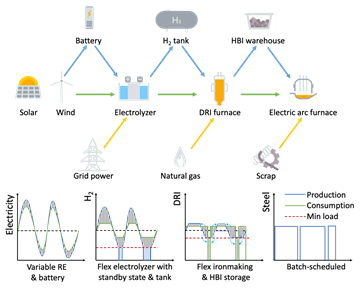
Figure 1. Schematic diagram illustrating the system configuration and operational flexibility concepts for hydrogen-based steelmaking.
To address these challenges, the research team constructed a mixed-integer linear programming model covering multiple stages of "electricity-hydrogen-iron-steel" for renewable-dominant hydrogen-based steel systems. This model simulates the operation of wind and solar power generation, electrolytic hydrogen production, hydrogen-based reduction shaft furnaces, and electric arc furnaces on an hourly basis. By integrating various buffering units such as electricity storage, hydrogen storage, and reduced iron storage, the model achieves joint optimization of capacity configuration and flexibility strategies across all stages. System evaluations conducted across five representative steel-producing cities in China revealed that implementing a full-process flexibility synergy strategy could reduce the levelized cost of steel by 6% to 10% compared to a baseline scenario relying solely on the flexible operation of electrolyzers. Furthermore, this flexibility mechanism reshapes the logic of system configuration: by moderately over-sizing the production capacities of electrolyzers, shaft furnaces, and electric arc furnaces, the required installed capacities of photovoltaic panels and batteries can be substantially reduced.
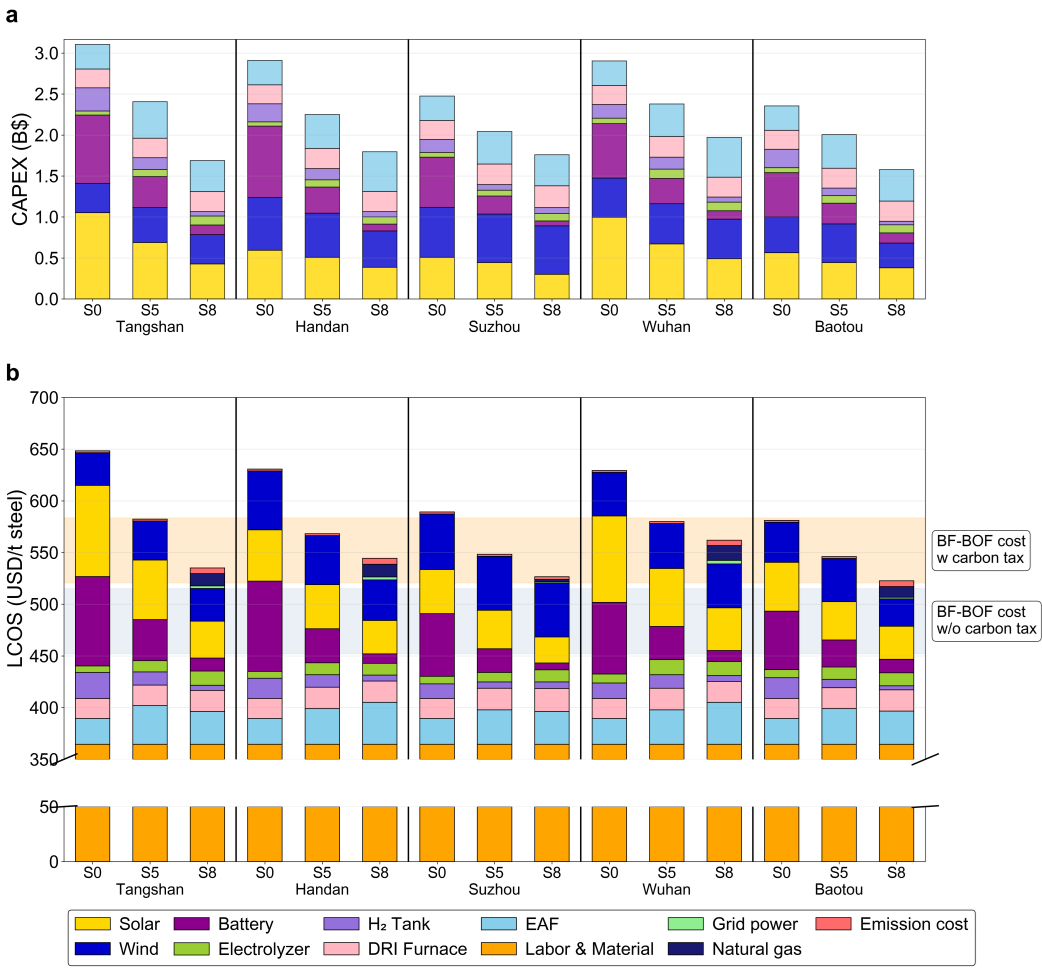
Figure 2. Breakdown of upfront capital investment and cost per tonne of steel for hydrogen-based steelmaking across different scenarios and regions.
The study concludes that in systems with high proportions of renewable energy, industrial system design must shift from the traditional paradigm of "continuous stable operation" to a new logic characterized by "flexible operation and moderate capacity over-sizing." The competitiveness of hydrogen-based steelmaking depends not only on the costs of green electricity and green hydrogen but also critically on the system's ability to achieve multi-stage flexibility synergy. This system design method is scalable and applicable to other energy-intensive industries such as chemicals, offering a replicable pathway for deep decarbonization in hard-to-abate sectors.
The paper's first author is He Yuezhang, a 2025 Ph.D. graduate from Tsinghua's Department of Energy and Power Engineering. The corresponding authors are Prof. Li Zheng, Associate Researcher Peng Tianduo (from Tsinghua's Institute for Carbon Neutrality and Institute for Climate Change and Sustainable Development), and Associate Prof. Jesse D. Jenkins from Princeton University. Co-authors include Wang Zhenqian (2023 Ph.D. candidate) and Yang Xingyuan (2022 Ph.D. candidate) from Tsinghua’s Department of Energy and Power Engineering; Mohamed Atouife (Ph.D. candidate) from Princeton University; and Daniel De Castro Gomez, Dr. Xin He, and Omar Hurtado Perez from Saudi Aramco.
Paper Link: https://doi.org/10.1039/D6EE00643D


 Latest recommendations