1.About 2026 CNEST International Forum
CNEST International Forum is an annual international forum series hosted by Tsinghua University to facilitate global discussion on cutting-edge science and technology issues and solutions of carbon neutrality and energy system transformation.
The 2026 CNEST International Forum will be held on May 20-22, 2026 in Changping District, Beijing. It invites 300-400 high-level experts from academia, industry, and policy-making from around the world, aiming to shape global consensus on CNEST related issues and improve strategic planning of the CNEST multilateral research collaboration program initiated by Tsinghua. The Forum is co-chaired by Prof. Peixue Jiang from Tsinghua Department of Energy and Power Engineering and member of the Chinese Academy of Sciences; and Prof. Deliang Chen from Tsinghua Department of Earth System Sciences and member of the European Academy of Sciences and Arts. The Forum’s Science Committee is chaired by Prof. Kebin He from Tsinghua Institute for Carbon Neutrality and member of the Chinese Academy of Engineering.
The 2026 CNEST Forum is now calling for original submissions of 250-word abstracts from academic, industry, and policy professionals, especially abstracts for review and perspective papers. Outstanding papers will be invited for oral or poster presentations at the Forum, and may also be invited for publication in partner journal. Academics and researchers, corporate executives, pilot project managers, policy analysts, government administrators, and senior science and tech journalists are all welcome to submit.
This year’s Forum is supported by Technology Review for Carbon Neutrality, an open-access journal hosted by Tsinghua that serves as a technology observatory and policy connector for global decision-makers. It publishes reviews and perspectives from academic, industry, and policy experts, as well as case studies and in-depth journalistic features.
2.Areas of submission
The Forum welcomes a wide range of topics, including but not limited to -
Area 1:
Energy transition planning and assessment
--Transition pathways
--Impact analysis
--Risk assessment
--Climate resilience assessment
--Just transition assessment
--Disruptive technology forecast
--Digital twin applications
Area 2:
Carbon monitoring and accounting
--GHG monitoring developments
--Carbon footprint accounting frameworks, methodologies, and database infrastructure
--Carbon market developments
--Carbon tax impact
Area 3:
Energy and power network
--Renewables-based power system reliability
--Climate resilient power system
--Disruptive frontiers: e.g. high-power optical transmission, space solar power station, etc.
Area 4:
AI and energy
--Multi-scale modeling and simulation integrating energy, carbon, material, and information flows
--Green AI computing and data center cooling
--AI-assisted energy system planning and security
--Space computing
Area 5:
key clean technologies
--CCUS materials, technologies, demonstrations, and impacts
--hydrogen industry chain
--Advanced energy storage technologies
--Zero-carbon industrial parks
--Non-power energy (industrial excessive heat, geothermal, bioenergy, etc.)
--Disruptive technologies: perovskite solar cells, artificial photosynthesis
Area 6:
digital twin applications
Area 7:
international collaboration
--Needs, advantages, and challenges for international collaboration
--Successful or failed cases, operational models, and lessons learnt for international collaboration.
The abstract should be original without prior publication and offer unique insights with academic, industry, policy significance. It may address: key technological needs for future R&D, competing technology routes, cutting-edge science discoveries and technology innovations; key lessons learnt, current barriers, and policy needs in technology deployment and engineering scale-up; balance of interests, unique national/regional circumstances, and risk assessment involved in policy design, as well as changes and adaptation in policy implementation.
Warning: corporate advertisement without meaningful contribution to the forum discussion will not be accepted.
3.Benefits of submission
Opportunity to present your latest findings at the high-level international forum and get feedbacks for future innovation.
Opportunity to win “best oral presentation” and “best poster” awards. Winners will be announced at the closing ceremony and presented with forum certificates.
Network with like-minded scientists, industry executives, and policy planners.
Opportunity to be invited for publication in the TRCN journal, free of charge. Once invited, all submitted papers will undergo the journal’s standard peer-review procedure.
4.Submit your abstract
Submit a structured abstract in English (less than 250 words), including: Background (main issue/challenge/gap and its real-world significance), Methods, Findings, Interpretation (including recommendations).
Please also specify in the abstract: all authors; affiliations of all authors, the corresponding author and email address, and submitting author’s contacts, and preference for oral or poster presentation.
Please submit your abstract to: carbontr@tsinghua.edu.cn. Please name the title of the email as: “CNEST Forum submission – area – review/perspective/research/journalistic feature – corresponding author’s name (affiliation) - short title”.
Deadline for submission: April 30, 2026.
Following assessment by an expert committee, you will be notified by May 10, 2026 through email whether your contribution has been accepted for presentation. Once accepted, the oral presentation may be allowed 10 minutes to present in a forum session. The poster should use A0 size (841 ×1189mm), vertical orientation (portrait). Poster presenters will be provided with a designated board area for displaying and introducing their poster.
2025 International Forum on Carbon Neutrality and Energy System Transformation (CNEST)
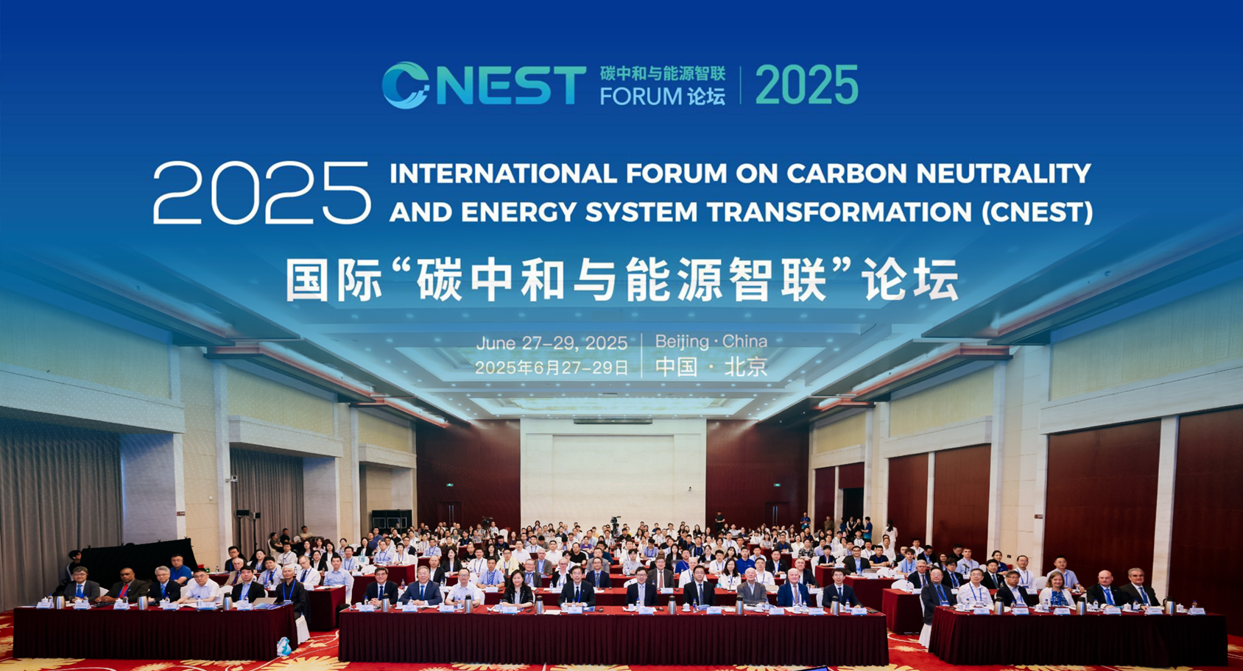
The 2025 International Forum on Carbon Neutrality and Energy System Transformation (CNEST) was successfully held in Beijing from June 27-29. As the inaugural international forum on the multilateral collaboration program CNEST, the event brought together over 400 participants from 19 countries. Attendees included representatives from universities, research institutes, enterprises, and international organizations. The forum featured the launch of the CNEST Beijing Initiative and Technology Review for Carbon Neutrality, an international journal that will serves as an open, neutral, and thoughtful global platform of communication on CNEST.


 Latest recommendations