1. Basic Information
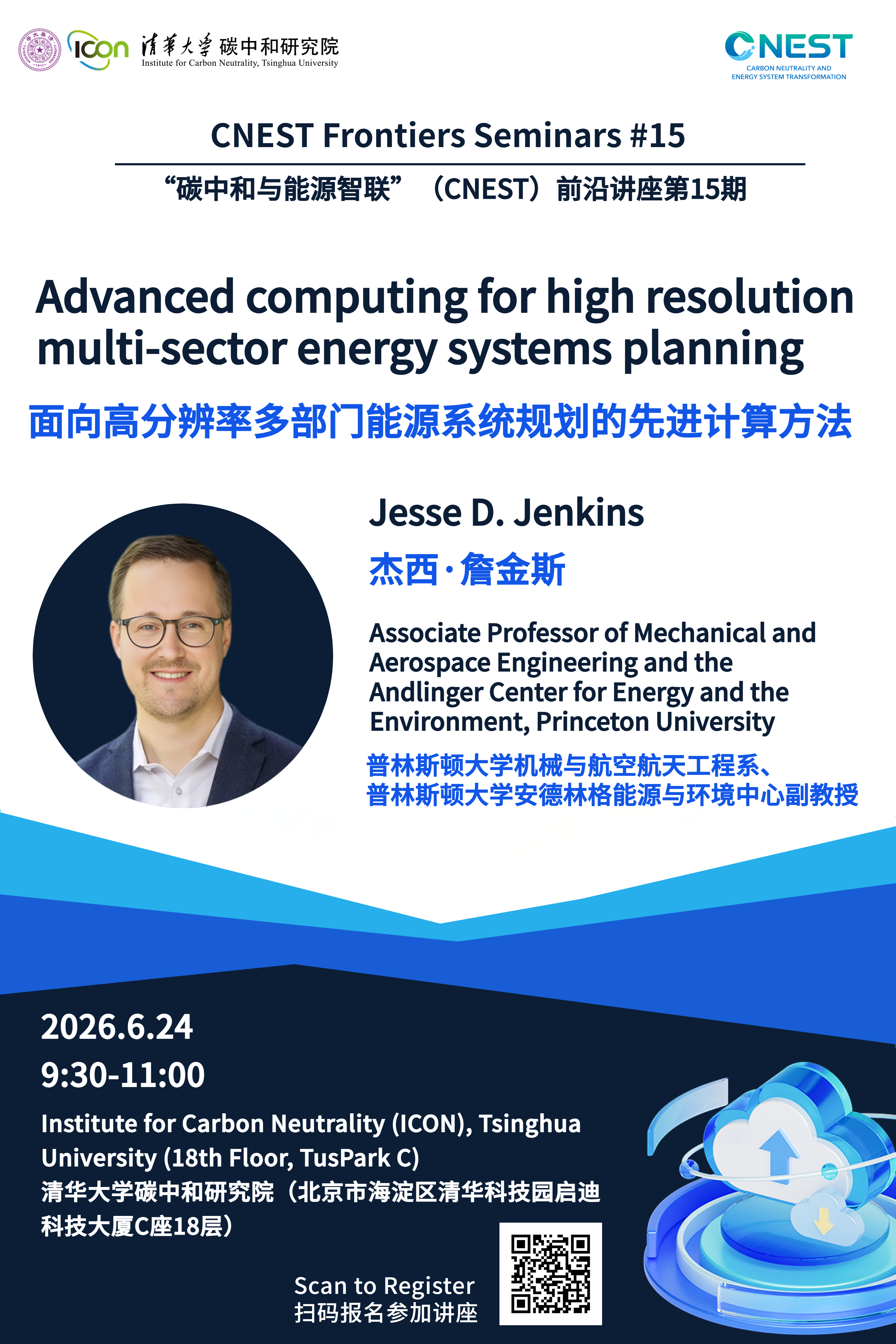
Date: June 24, 2026 9:30–11:00
Venue: Institute for Carbon Neutrality, Tsinghua University (18th Floor, Tower C, Science and Technology Building, TUS Park, Haidian District, Beijing)
Speaker: Jesse D. Jenkins
Lecture Title: Advanced computing for high resolution multi-sector energy systems planning
2. Main Agenda
(1)Welcome and Introduction
(2)Keynote Lecture
(3)Discussion and Exchange
3. Lecture Abstract
The next wave of energy and industrial decarbonization will result in complex flows of electricity, hydrogen, bioenergy, CO2, and other commodities, linking energy and industrial supply chains in fundamentally new ways. With variable renewable energy central to future energy supply, decarbonization pathways must also be robust to weather variability and extreme events. Computational models are essential to explore these complex dynamics and guide decision-making. However, most existing multi-sector energy planning models are inadequate to this task with limited operational description of the electricity system and highly abstracted temporal resolution. An accurate representation of the electricity sector alone requires large-scale optimization models spanning hundreds of millions of variables and constraints covering optimal capacity and dispatch. As electrification of heating, transportation and industry progresses, models must not only represent the power sector with high fidelity, but also substantially expand scope to multiple energy and industrial commodity flows, resulting in intractable models using even the best commercial solvers. This lecture will discuss several emerging strategies to deliver a step-change improvement in computational performance of large-scale mixed-integer linear programs for multi-sector energy and industrial systems planning, as well as introduce MacroEnergy.jl, a new open-source tool for modeling the future of energy and industrial decarbonization.
4. Speaker Biography

Jesse D. Jenkins
Jesse D. Jenkins is an associate professor and macro-scale energy systems engineer at Princeton University with a joint appointment in the Department of Mechanical and Aerospace Engineering and the Andlinger Center for Energy and Environment. He leads the Princeton ZERO Lab (Zero-carbon Energy systems Research and Optimization Laboratory), which focuses on improving and applying optimization-based energy systems models to evaluate and optimize low-carbon energy technologies, guide investment and research in innovative energy technologies, and generate insights to improve energy and climate policy and planning decisions.
Prof. Jenkins earned a PhD in Engineering Systems and SM in Technology & Policy from the Massachusetts Institute of Technology, worked previously as a postdoctoral environmental fellow at the Harvard Kennedy School, and spent six years as an energy and climate policy analyst prior to embarking on his academic career.
Prof. Jenkins has published more than 45 peer-reviewed papers to date in high-impact journals including Science, Nature Energy, Joule and Applied Energy. He served on the National Academies of Science Engineering and Medicine expert committee on Accelerating Decarbonization of the U.S. Energy System, was a principal investigator and lead author of Princeton’s landmark Net-Zero America study, and leads the REPEAT Project, which provides regular, timely, and independent environmental and economic evaluation of federal energy and climate policies as they’re proposed and enacted.
Prof. Jenkins is also co-founder and Chief Technology Officer of Firma Power, where he leads development of the Firma OS optimization and decision support software suite. Firma Power delivers load-enabling portfolios of clean firm power to accelerate time-to-power, simplify origination, and manage risk for large electricity users.
He also regularly provides technical analysis and policy advice for non-profit organizations, policy makers, investors, and early-stage technology ventures working to accelerate the deployment of clean energy. Dr. Jenkins currently serves on the advisory boards of Eavor Technologies, Rondo Energy, Dig Energy Karman Industries and Emerald AI, and is a scientific and technical advisor to Energy Impact Partners and MUUS Climate Partners.
5. Registration
A limited number of in-person attendance slots are available for this seminar. If you are interested in participating, please scan the QR code below to register before 12:00 on June 23, 2026. The organizing committee will send a confirmation email to successful registrants.



 Latest recommendations