On September 1, the 46th Carbon Neutrality Academic Salon, themed "Coordinated Pollution Reduction and Carbon Mitigation: Systems and Practices," was successfully held in Beijing. The event was hosted by the Institute for Carbon Neutrality at Tsinghua University(Tsinghua ICON) and organized by the China Clean Air Policy Partnership (CCAPP). The meeting was chaired by Researcher Lei Yu, Director of the Atmospheric Environment Institute and Head of the Carbon Neutrality Center at the Ministry of Ecology and Environment's Appraisal Center for Environment and Engineering.
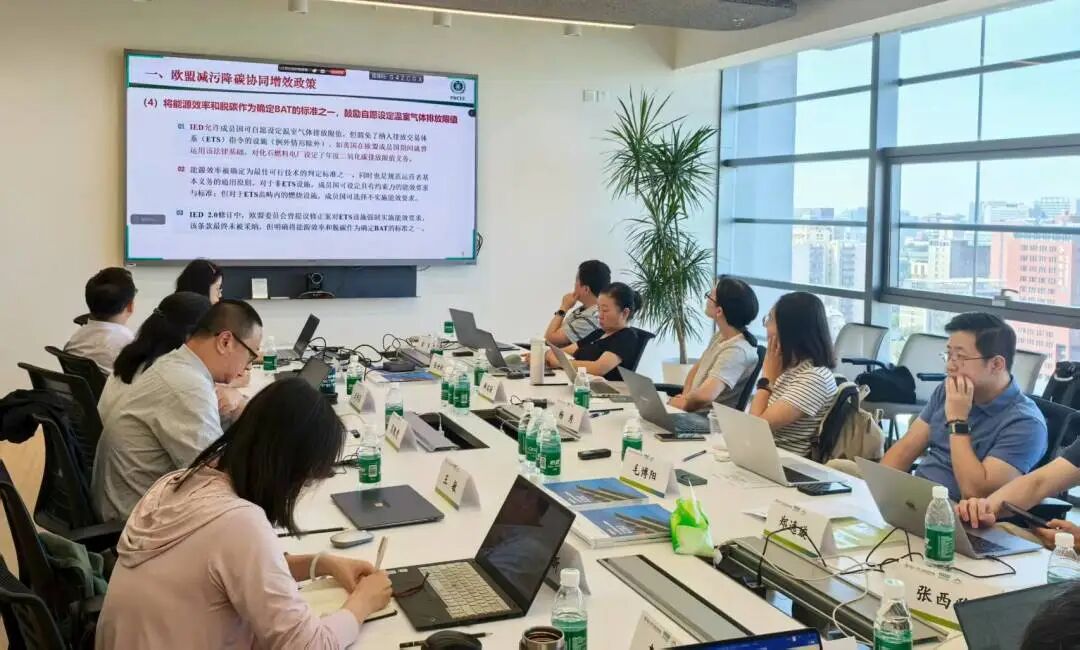
Salon Event Scene
Experts and scholars from Tsinghua University, Peking University, Renmin University of China, Beijing Normal University, the Ministry of Ecology and Environment's Appraisal Center for Environment and Engineering, the Foreign Environmental Cooperation Center of the Ministry of Ecology and Environment, the Policy Research Center for Environment and Economy of the Ministry of Ecology and Environment, the Chinese Research Academy of Environmental Sciences, and the National Center for Climate Change Strategy and International Cooperation attended the event and engaged in in-depth discussions. This session focused on how to build and improve policy and institutional systems and promote local practices in the context of air quality improvement and actions toward carbon peaking and carbon neutrality. The event was live-streamed simultaneously via the WeChat video channels of Tsinghua University's Institute for Carbon Neutrality and CCAPP, attracting over 3,200 online viewers.
Professor Mao Xianqiang from the School of Environment at Beijing Normal University delivered a report titled "Synergistic and Antagonistic Effects of Carbon Emission Reduction Policy Tools." He proposed a hybrid policy evaluation framework that combines a computable general equilibrium (CGE) model with a discriminant matrix. Through policy scenario analysis and effect simulation, this framework evaluates the synergistic and antagonistic effects of policy tool combinations—such as carbon emission trading, subsidies for new energy storage, and mandatory energy efficiency improvements—across environmental, energy, and economic dimensions. The study reveals real-world scenarios where different policies can achieve "1+1>2" or "1+1<2" outcomes. The research shows that dual- and triple-policy combinations often exhibit weak synergistic effects, with antagonistic effects appearing in a few scenarios. In multi-criteria analysis, triple-policy combinations ranked higher than single- or dual-policy combinations. The findings suggest that future policy design needs to pay greater attention to the interactions and potential conflicts among policy tools.
Professor Wang Shuxiao from the School of Environment at Tsinghua University presented a report on "Optimizing Synergistic Pathways for Urban Air Quality Improvement and Carbon Emission Reduction." She pointed out that while significant synergistic benefits between pollution reduction and carbon mitigation have been observed at the national level over the past decade, there is still a general lack of actionable governance plans at the city level. By constructing an integrated assessment model framework for coordinated carbon and pollution governance, Professor Wang's team developed a decision support system for urban coordinated pollution reduction and carbon mitigation. Using Linfen City in Shanxi Province as a case study, the team systematically analyzed the city's energy and industrial structure and pollution sources, identified priority areas for air pollution control, and proposed optimized pathways for reducing air pollutants and carbon emissions in key sectors such as steel, power, scattered coal, and transportation, along with expected synergistic governance outcomes. The research indicates that optimizing and upgrading key industries, phasing out outdated production capacity, strictly controlling coal consumption, continuing efforts to eliminate scattered coal use, and optimizing the freight transportation structure are effective measures for Linfen to achieve the "dual goals" of air quality compliance and carbon peaking.
Researcher Wang Min from the Policy Research Center for Environment and Economy of the Ministry of Ecology and Environment delivered a report titled "Policies and Insights on Coordinated Pollution Reduction and Carbon Mitigation in Major Economies." She systematically reviewed the policy practices and latest developments of the European Union in promoting synergistic pollution reduction and carbon mitigation. She noted that the European Green Deal integrates zero pollution and climate neutrality goals into its overall development strategy. The newly revised Industrial Emissions Directive also synchronously incorporates pollutant reduction and decarbonization into emission reduction targets, using permits and environmental management systems as key tools and ensuring maximized benefits of selected and implemented emission reduction technologies based on Best Available Techniques conclusions. The EU experience shows that legislative support, systematic assessment, multi-stakeholder participation, and technological innovation are key to promoting synergistic pollution reduction and carbon mitigation. China should, based on its actual conditions, strengthen requirements for coordinated pollution reduction and carbon mitigation in laws and regulations, improve the assessment of relevant policies and action effectiveness, integrate greenhouse gas reduction requirements into pollutant discharge permit management, and guide and encourage stakeholder participation in decision-making for coordinated pollution reduction and carbon mitigation.
During the subsequent discussion session, experts including Professor Zhang Shiqiu from Peking University, Professor Chang Dunhu from Renmin University of China, Researcher Yang Xiu from Tsinghua University, Senior Engineer Li Liping from the Policy Research Center for Environment and Economy of the Ministry of Ecology and Environment, Senior Engineer Zhang Xin from the Chinese Research Academy of Environmental Sciences, and Senior Engineer Xie Ruili from the National Center for Climate Change Strategy and International Cooperation engaged in in-depth exchanges around the salon's theme, offering reflections and summaries on the priorities and challenges of coordinated pollution reduction and carbon mitigation in China from a macro perspective.
The experts agreed that, while significant achievements have been made in coordinated pollution reduction and carbon mitigation since China's 14th Five-Year Plan period, the marginal benefits of policy tools are gradually diminishing. How to scientifically design policy combinations, avoid potential antagonistic effects, and enhance overall synergistic efficiency has become an urgent issue to address. The experts pointed out that future work needs to focus more on differentiated challenges at the local level, identifying priority areas and key measures based on the industrial structure, energy endowments, and governance foundations of different cities and regions, to promote the formation of practical and feasible pathways. Simultaneously, the discussion emphasized the need to further improve China's governance systems and policy frameworks by drawing on advanced international experience. There was consensus that advancing coordinated pollution reduction and carbon mitigation is not merely an issue of technological and policy optimization but also a profound transformation of governance systems and institutional mechanisms. It is essential to strengthen multi-departmental co-governance, cross-regional cooperation, and whole-society participation to achieve a "win-win" for air quality improvement and the goals of carbon peaking and carbon neutrality, providing a solid guarantee for building a Beautiful China and promoting green transformation.


 Latest recommendations