The international workshop "Global Life Cycle Assessment (LCA) Platform: From Vision to Action," jointly organized by Tsinghua University, the United Nations Environment Programme (UNEP) Life Cycle Initiative (LCI), and the University of Padova (Italy), was successfully held on July 10-11, 2025. The event took place at Tsinghua University's overseas base – the China-Italy Design Innovation Hub in Milan, Italy. The workshop defined a shared vision and pathway for developing an interconnected, interoperable, and trustworthy global LCA infrastructure.
The outcome report of the workshop has now been publicly released globally on the UNEP LCI website.
This work received joint support from the Energy Foundation, the "Carbon Neutrality and Energy System Transformation" (CNEST) Multilateral Cooperation Program, and the Carbon Footprint Industrial Technology Innovation Alliance.
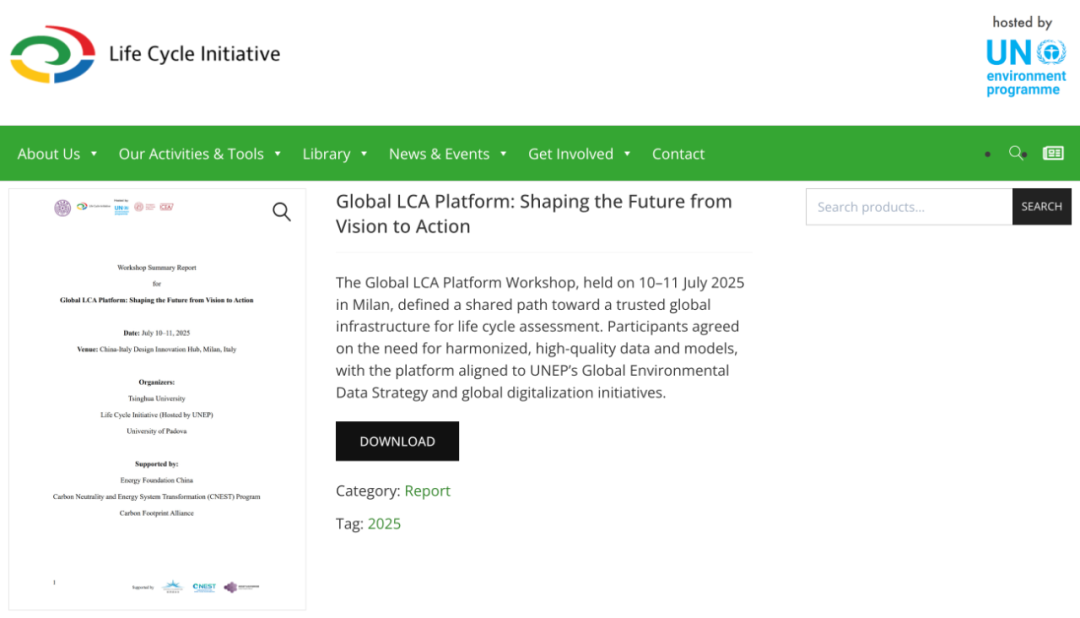
UNEP LCI Officially Releases Milan Workshop Report
The report can be accessed at: https://www.lifecycleinitiative.org/library/global-lca-platform-shaping-the-future-from-vision-to-action/
Global LCA Platform: Shaping the Future from Vision to Action
Introduction
The Global Life Cycle Assessment (LCA) Platform Workshop was held in Milan, Italy, on July 10-11, 2025. Co-organized by Tsinghua University, the United Nations Environment Programme (UNEP) Life Cycle Initiative (LCI), and the University of Padova, the workshop brought together stakeholders from government, industry, academia, and international organizations to chart a collective action path towards building a credible, federated LCA infrastructure.
Participants unanimously affirmed that robust, harmonized, and accessible life cycle data, methods, and models are urgently needed to better support global scientific research, business practices, and policymaking. Consensus was reached on defining the Global LCA Platform as an interoperable and inclusive system for enabling transparent data exchange, quality assurance, and the globalized application of LCA.
This platform aligns with the five pillars of the UNEP Global Environmental Data Strategy (Governance, Interoperability, Quality, Access, and Capacity Building) and contributes to international digital transformation initiatives, including the "Digital for Circular Economy (D4CE) Impact Initiative" under the Coalition for Digital Environmental Sustainability (CODES) framework. A core principle emphasized by participants is achieving "mutual trust in models and data" within the platform framework, ensuring all stakeholders can rely on the integrity, transparency, and consistent quality of LCA-related data.
Platform Architecture
Participants agreed to build a federated systems architecture that connects existing national, regional, and commercial databases while supporting modular and scalable development. Key features include:
A unified data vocabulary and standardized APIs to ensure interoperability;
Tiered access controls balancing openness with data confidentiality and ownership;
Comprehensive quality control, version management, and user feedback mechanisms;
Support for open-source and commercial contributions, enabling regional and sectoral integration, with a core focus on open-source data;
Accompanying capacity-building measures to engage emerging global LCA communities and students.
Data Standards and Interoperability
Consensus was reached on establishing a flexible, modular global LCA data schema to ensure interoperability and traceability. Associated goals and follow-up actions include:
Near-term Actions: Conduct cross-database mapping, harmonize and consolidate nomenclature, and establish reliable bridging protocols;
Long-term Goal: Achieve unified standards and seamless data exchange with transparent audit traceability;
Guiding Principles: Context-driven data access, minimum disclosure requirements, and alignment with both legacy and emerging systems.
Governance and Trust
Governance was identified as a core cornerstone of credibility and trust. The platform's trustworthiness relies on establishing "mutual trust in models and data" through transparent processes, certification, and continuous verification. Participants supported:
An inclusive multi-stakeholder governance structure with central and distributed "satellite nodes";
Transparent processes for decision-making, compliance, and stakeholder engagement;
Structured collaboration with governments, industry, and standards bodies (e.g., ISO, GHG Protocol);
Trust mechanisms based on peer review, transparent certification, and feedback loops;
Sustainable business and funding models to ensure long-term viability.
Working Groups and Next Steps:
To implement the roadmap, four initial working groups were established. Each will develop Terms of Reference (ToR), identify leads, and report progress at the next meeting.
Standards & Methodologies WG: Develop shared data schemas, mapping protocols, and harmonize LCA models and Life Cycle Impact Assessment (LCIA) methods.
Data Quality, Review & Management WG: Define quality indicators, review and certification processes, manage dataset lifecycles, and incorporate user and AI-assisted verification to ensure mutual trust in models and data within the platform.
Platform Governance & Stakeholder Engagement WG: Design the governance model, roles, and engagement mechanisms; establish compliance and participation strategies; determine funding models ensuring sustainability; provide onboarding and training support.
Technical Development & Infrastructure WG: Build and maintain the IT backbone, APIs, cybersecurity, and open-source integrations; ensure federated operation and availability.
Next Steps:
Launch a call for expressions of interest in participating in the working group activities.
Convene kick-off meetings for the four working groups to clarify initial responsibilities and output targets.
Develop a communication and outreach roadmap, consolidating the platform's positioning, technical, and governance blueprints for global dissemination and fundraising.


 Latest recommendations