On September 28, 2025, the second full-author meeting for the 2025 Report of Synergetic Roadmap on Carbon Neutrality and Clean Air for China was successfully held in Beijing. The meeting was attended in person or online by the report's working group co-chairs, Academician He Kebin (Dean of the Tsinghua University Institute for Carbon Neutrality) and Academician Wang Huijun (Director of the Academic Committee of Nanjing University of Information Science & Technology), along with over 30 experts involved in the report's compilation.
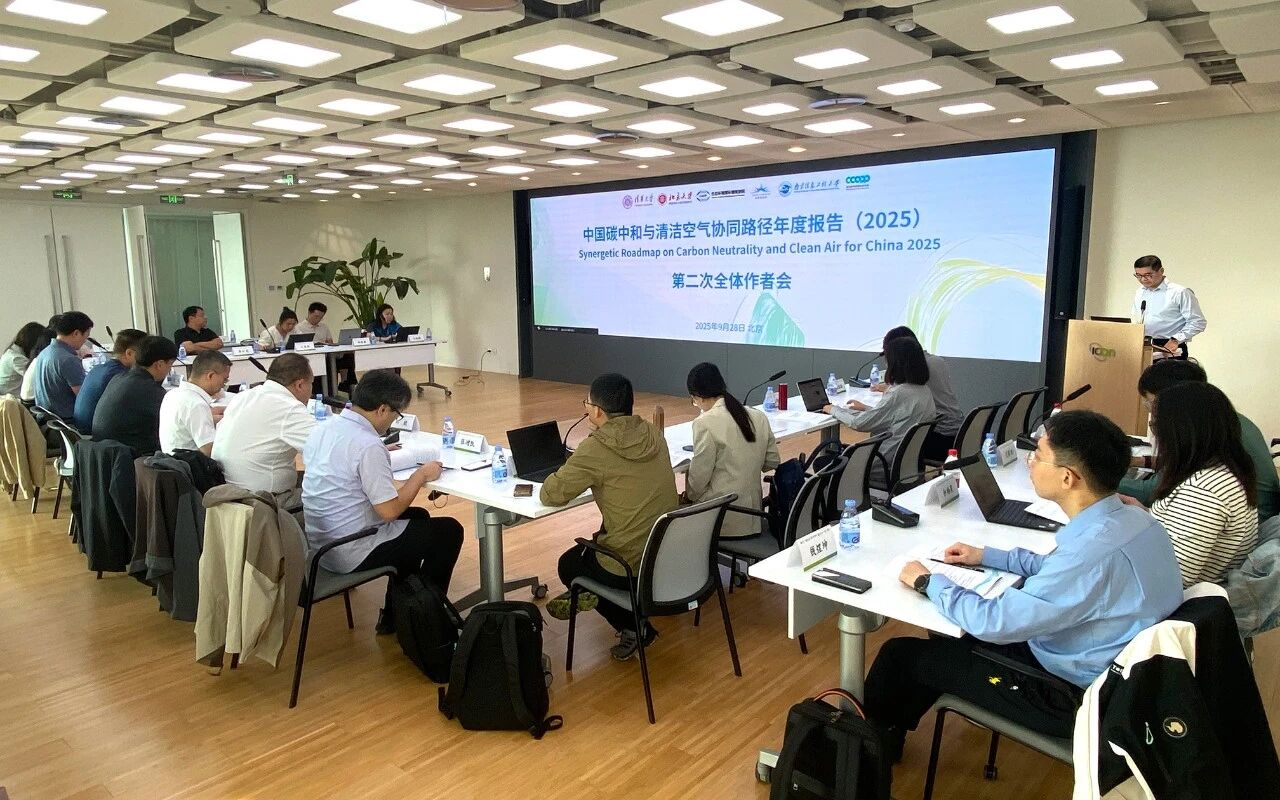
Meeting Venue
Liu Xin, Director of the Environmental Management Program at the Energy Foundation, delivered the opening remarks. She expressed hope that this year's report would build upon the strengths of the previous four years by conducting a more detailed analysis of core and hot-button issues. She also emphasized the need to closely align with China's new round of Nationally Determined Contribution (NDC) targets. Adopting a forward-looking strategic perspective, the report aims to provide clearer and more actionable guidance for the synergistic pathways of carbon neutrality and clean air during the 15th Five-Year Plan period.
Professor Lu Xi, Assistant Dean of the Tsinghua University Institute for Carbon Neutrality and convener for the 2025 report, introduced the compilation background, current progress, and next steps for this year's edition. Professor Lu Xi pointed out that the report maintains the main framework of the indicator system across five key areas: air pollution and climate change, governance systems and practices, structural transformation and control technologies, sources and sinks of atmospheric components and emission reduction pathways, and health impacts and co-benefits. It tracks progress on various indicators, analyzes obstacles within China's carbon neutrality and clean air synergy pathway, and proposes solutions. The report updates some indicators, adds comparative analyses of domestic and international developments, focuses on tracking progress during the 14th Five-Year Plan period, and summarizes achievements and gaps. Following this, five working group representatives—Professor Yin Zhicong (Vice Dean of the School of Atmospheric Sciences, Nanjing University of Information Science & Technology), Lei Yu (Director of the Atmospheric Environment Institute and Director of the Carbon Peak and Carbon Neutrality Research Center at the Appraisal Center for Environment and Engineering, Ministry of Ecology and Environment), Professor Lu Xi, Researcher Qin Yue (School of Environmental Science and Engineering, Peking University), and Professor Chen Renjie (School of Public Health, Fudan University)—presented their respective group's progress and content updates. Attending experts provided comments and engaged in discussion.
The working group co-chairs, Academicians He Kebin and Wang Huijun, affirmed the 2025 report's framework and overall content, offering the following guiding suggestions. Academician Wang Huijun emphasized that each working group should rigorously ensure the accuracy and authority of data used for describing the current situation, strengthen internal communication to guarantee consistency of data and content across different chapters, highlight new trends, issues, and challenges in China's pollution and carbon reduction efforts to address the concerns of the public, government, and international peers, and, furthermore, enhance the report's summary of key viewpoints. Recommendations should be targeted and pertinent, conveying conclusions clearly and effectively to policymakers, academia, and society. Academician He Kebin noted that this year's report should fully incorporate China's new NDC targets, aligning with national strategy. He mentioned that the compilation of integrated emission inventories for air pollutants and greenhouse gases is gradually being implemented in key regions and cities. With the proposal of China's new NDC targets and the advancement of the 15th Five-Year Plan formulation, local governments' emphasis on compiling and applying integrated inventories is expected to increase significantly, thereby powerfully advancing pollution and carbon reduction during the 15th Five-Year Plan period. Additionally, he suggested organizing cross-working group academic exchanges and thematic seminars to further highlight the core value and critical role of "synergy" under multiple objective pressures, providing key recommendations and directions to support China's synergistic pollution reduction and carbon mitigation efforts. As the next step, each report working group will review their tasks based on the meeting discussions and expert opinions, engage in further discussion, refine the indicator system, and advance the report compilation work.
The Report of Synergetic Roadmap on Carbon Neutrality and Clean Air for China series is supported by the Energy Foundation and jointly initiated by Tsinghua University, Peking University, the Appraisal Center for Environment and Engineering of the Ministry of Ecology and Environment, Nanjing University of Information Science & Technology, and the Clean Air Policy Partnership. It brings together leading domestic expert teams to compile the reports, aiming to track the latest progress in China's coordinated governance of air pollution and climate change, elucidate the current status of air quality and climate change and their impacts, and identify areas needing reinforcement and future synergistic pathways. The 2025 report is the fifth volume in the series. The first draft is currently complete. This meeting aimed to facilitate further exchange and discussion on the main content and conclusions of the draft report and to advance subsequent integration, revision, and refinement work.


 Latest recommendations