With the application of digital technologies, digital freight platforms (or digital freight matching platforms) have emerged as a new business model and an innovative form of horizontal collaborative transport, drawing attention to their potential to improve operational efficiency in road freight. Conducting large-sample empirical studies at the national scale and systematically assessing the impact of freight digitalization and operational efficiency improvements on industry decarbonization pathways is critical. Furthermore, as zero-emission vehicles (such as electric and hydrogen fuel cell trucks) are increasingly deployed, challenges in real-world operations—including reduced payload capacity and limited range—may also significantly affect freight system decarbonization pathways, warranting in-depth research.
Recently, Peng Tianduo, Associate Research Fellow at the Climate Change and Carbon Neutrality Strategy Research Center, Institute for Carbon Neutrality, Tsinghua University, and the Institute of Climate Change and Sustainable Development, Tsinghua University; Ou Xunmin, Research Fellow at the Climate Governance and Carbon Finance Research Center, Institute for Carbon Neutrality, Tsinghua University, and the Institute of Energy, Environment and Economy, Tsinghua University; along with teams from the King Abdullah Petroleum Studies and Research Center (KAPSARC), South China University of Technology, and Southwest Jiaotong University, focused on China's road freight sector—a key source of carbon emissions. They systematically quantified and analyzed the efficiency-enhancing effects of digital freight platforms on medium- and heavy-duty truck operations, clarifying the synergistic mechanisms between two decarbonization pathways: logistics fleet operational optimization and low-carbon technology. This research provides crucial scientific evidence and empirical support for deep decarbonization of the road freight industry in China and globally.
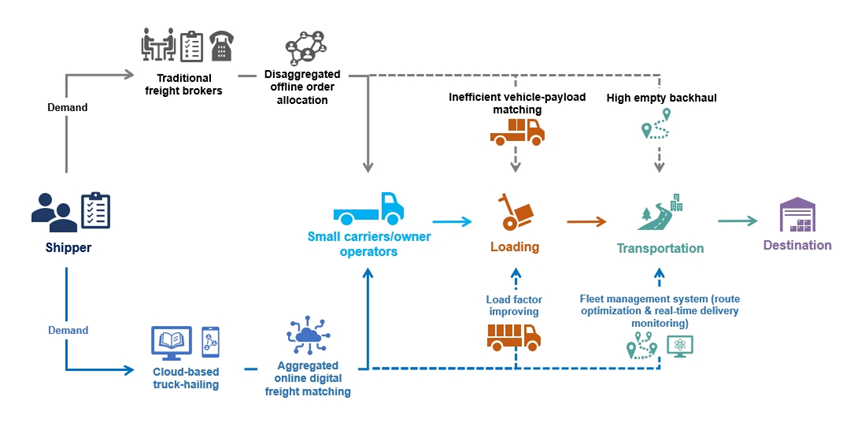
Figure 1: Comparison of operational logic and characteristics between traditional offline freight models and digital freight platform models
Based on 51,021 real-world long-distance digital freight transaction records in China, the study systematically evaluated the impact of digital freight platforms on operational efficiency by examining key indicators such as vehicle-cargo matching characteristics, empty mileage rate, load factor, and average daily travel distance. The results show that digital freight platforms significantly reduce empty mileage rates and increase load factors through intelligent matching, route optimization, and real-time dispatching, thereby effectively improving overall operational efficiency. Further analysis indicates that operational efficiency improvements hold significant potential for road freight decarbonization and exhibit synergistic effects with vehicle technological advancements. Under moderate and optimistic scenarios, compared to a baseline scenario, the emission reduction contributions from increased load factors and reduced empty mileage rates between 2020 and 2035 exceed those from technological factors. In the long term (2035–2060), although technological progress (such as efficiency improvements and zero-emission vehicle penetration) will become the dominant force in emission reductions, operational efficiency improvements will continue to play an important role. More critically, efficiency improvements reduce unnecessary transport mileage, thereby helping to lower the fleet size and technology investments needed to achieve deep decarbonization. The study also notes that current zero-emission trucks still underperform conventional diesel trucks in terms of payload capacity and range, implying that more vehicles or higher driving intensity may be required to meet the same transport demand, which could partially offset emission reduction gains—an issue warranting close attention.
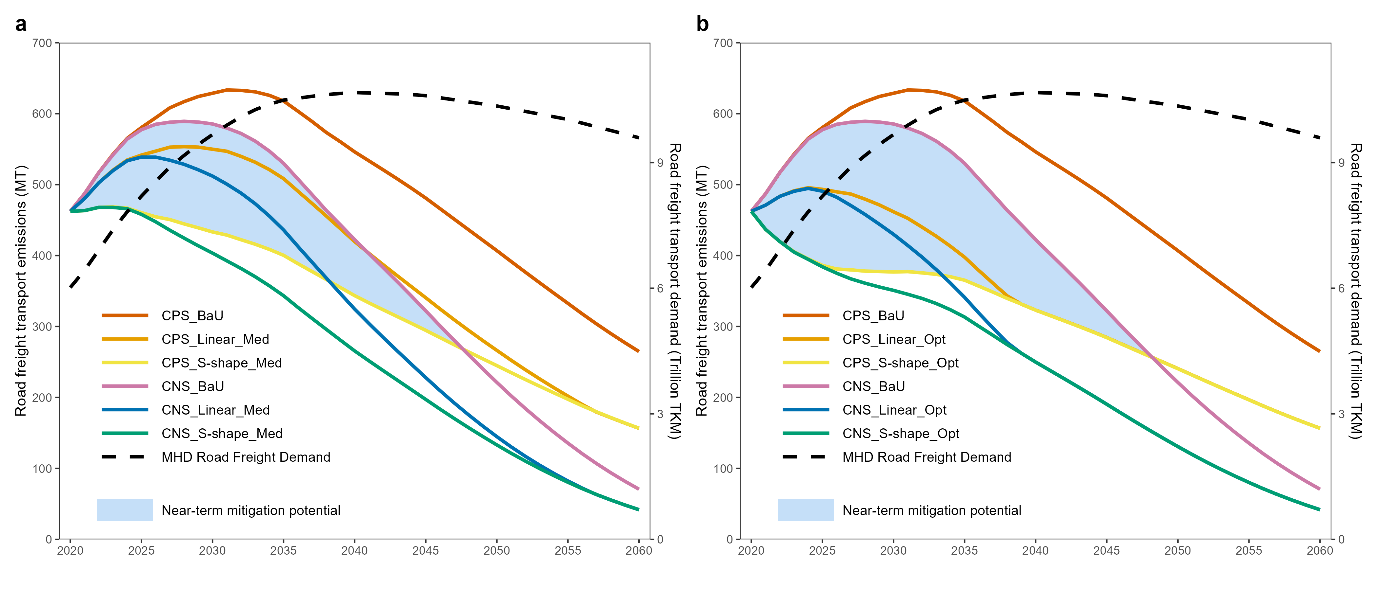
Figure 2: Decarbonization pathways for China's medium- and heavy-duty road freight under different scenarios. (a) CO₂ emissions under baseline and moderate scenarios; (b) Projected CO₂ emissions under baseline and optimistic scenarios. The shaded areas illustrate the near-term emission reduction potential of operational efficiency improvements relative to rapid low-carbon technology adoption.
The study also highlights potential "rebound effects": On one hand, transport efficiency improvements may lower costs, thereby stimulating additional freight demand and partially offsetting emission reduction benefits. On the other hand, improved road freight efficiency may attract cargo volumes originally carried by lower-carbon modes such as rail or water transport, leading to "reverse optimization" of the transport structure and increasing overall emissions. Additionally, reduced vehicle demand resulting from efficiency improvements may negatively impact employment for self-employed drivers who rely on driving for their livelihood. Therefore, future policy design needs to more comprehensively balance economic, social, and environmental impacts, and explore how cost savings can be channeled to support a just transition.
The research findings, titled "The potential role of truck-hailing and operational efficiency improvement in China's road freight decarbonization," were published online on April 2 in Nature Communications.
Dr. Xu Xun from KAPSARC is the first author of the paper. Associate Research Fellow Peng Tianduo, Research Fellow Ou Xunmin, and Dr. Xu Xun are co-corresponding authors. Co-authors include Professor Ou Shiqi and Professor Lin Zhenhong from South China University of Technology; Associate Professor Xu Zhandong, Professor Gan Mi, Dr. Li Dandan, and Professor Liu Xiaobo from Southwest Jiaotong University. The research was supported by the National Key Research and Development Program of China, the National Natural Science Foundation of China, as well as funding from KAPSARC, the Tsinghua-Toyota Research Center, and the Carbon Neutrality and Energy System Transformation (CNEST) multilateral collaboration program.
Link to paper: https://doi.org/10.1038/s41467-026-71160-1


 Latest recommendations