
Global climate governance has entered a critical decade, and energy sector decarbonization is the key battleground for China to achieve carbon neutrality. How can China chart a high-quality decarbonization pathway under multiple pressures, including continued energy consumption growth, relatively young infrastructure, and regional development imbalances? The journal Technology Review for Carbon Neutrality (TRCN) has published a landmark review article by Guo Siyue and other authors from the Institute of Energy, Environment and Economy, Tsinghua University, titled "Energy sector decarbonization in China: macro challenges, supporting technologies and systems, and policy recommendations." The article systematically examines the structural challenges of China's energy decarbonization, supporting technologies and systems, and a future-oriented technology roadmap and policy recommendations.
Citation: Guo S, Zhang X, Huang X, et al. Energy sector decarbonization in China: macro challenges, supporting technologies and systems, and policy recommendations. Technology Review for Carbon Neutrality, 2025, 1: 9550003. https://doi.org/10.26599/TRCN.2025.9550003
Author Affiliations
The first author of this article is Guo Siyue from the Institute of Energy, Environment and Economy, Tsinghua University. The corresponding authors are Zhang Da and Zhang Xiliang. Other co-authors include Zhang Xian from the Administrative Center for China's Agenda 21, Huang Xiaodan from the Energy Conservation and Environmental Protection Institute of CCID, Weng Yuyan from the Institute of Energy, Environment and Economy, Tsinghua University, and Zhao Weichen from University College London. The author team has long-standing expertise in energy system analysis, carbon market mechanisms, and technology roadmaps, and their research has repeatedly informed national-level policy formulation for carbon peaking and carbon neutrality.
Key Insights at a Glance
The article points out that China's energy sector decarbonization faces four major macro challenges:
Energy consumption is still growing: Unlike developed countries, China's energy consumption continues to rise, reaching 5.3 billion tons of coal equivalent in 2021, with fossil fuels accounting for 83.3%;
Severe geographic imbalances: Energy consumption is concentrated southeast of the Heihe–Tengchong Line, while renewable energy resources such as wind and solar, as well as carbon sequestration potential, are mainly in the northwest;
Relatively young infrastructure: The average age of coal-fired power plants is only 15 years (compared to over 30–40 years in Europe and the US), posing risks of lock-in effects and stranded assets;
Need to balance high-quality development: Decarbonization cannot come at the expense of energy security, industrial competitiveness, or social equity.
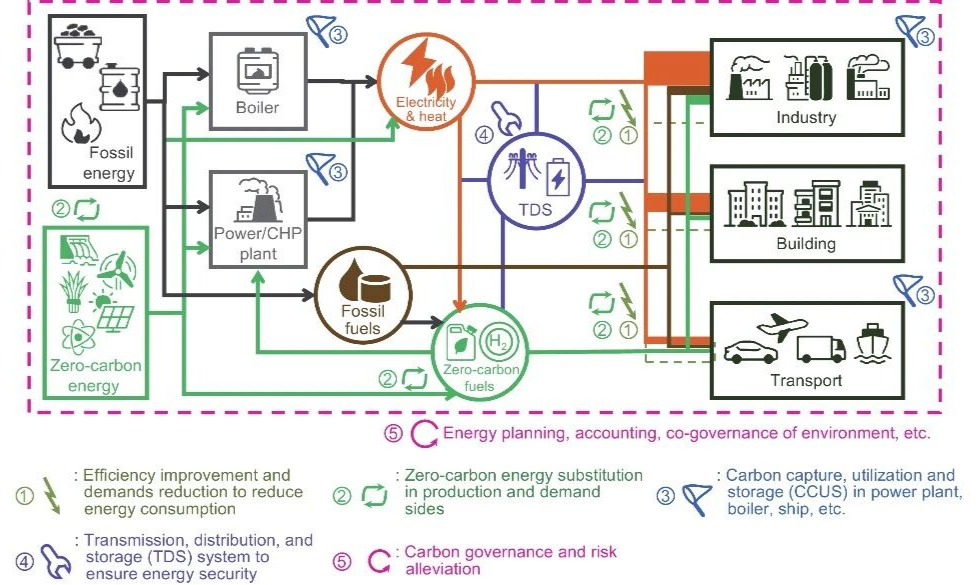
To address these challenges, the article proposes three categories of emission reduction support technologies and three enabling systems:
Supporting technologies:
Energy efficiency improvement and demand reduction (e.g., digital energy management, material lightweighting)
Zero-carbon energy substitution (renewables, nuclear, hydrogen, bioenergy)
CCUS (especially for existing coal-fired power capacity)
Enabling systems:
Power transmission, distribution, and storage systems (to accommodate high shares of variable renewables)
Carbon governance mechanisms (accounting, monitoring, reporting, verification, planning)
Risk management systems (decommissioning of retired equipment, critical mineral supply, land use)
Policy Recommendations: Dual‑Drive of Technology Roadmap and Carbon Market
The article emphasizes that the technology roadmap is a key top‑down design tool for energy decarbonization and should integrate the following dimensions:
Technology maturity and cost evolution (e.g., photovoltaic efficiency advancing from 20% toward the laboratory limit of 47.6%)
Competition and synergy among technologies (the dynamic changes in contribution shares of energy efficiency, renewables, and CCUS)
Leadership through technological innovation (not relying solely on labor cost advantages)
In terms of policy instruments, the national carbon emissions trading system (ETS) and the China Certified Emission Reduction (CCER) voluntary market are forming a dual‑drive mechanism. Simulation studies indicate that the current ETS provides incentives for CCUS in coal‑fired power, but additional policy design is needed to promote zero‑carbon energy. In the future, CCER is expected to cover more energy efficiency and clean power generation technologies.
The article concludes: "Climate change is a global challenge, and global cooperation plays an important role in technology deployment. China has made significant progress in transferring technologies, such as photovoltaic panels, to countries in the Global South. In the future, energy decarbonization technologies are expected to become a new frontier for international cooperation."
Citation: Guo S, Zhang X, Huang X, et al. Energy sector decarbonization in China: macro challenges, supporting technologies and systems, and policy recommendations. Technology Review for Carbon Neutrality, 2025, 1: 9550003. https://doi.org/10.26599/TRCN.2025.9550003


 Latest recommendations