As wind and solar power are integrated into the grid on a large scale, how can the grid cope with fluctuations driven by weather-dependent generation? From millisecond-response flywheel energy storage to hydrogen storage for seasonal peak shaving, China is building an energy storage technology network covering the full spectrum of timescales. The journal Technology Review for Carbon Neutrality (TRCN) has published a landmark review article by Liu Jianing and other authors from Tsinghua University, titled "The shifting technology landscape of electrical energy storage toward carbon neutrality in China." The article systematically examines the functional roles, breakthroughs and bottlenecks of various energy storage technologies in the power system, their spatiotemporal evolution pathways from 2025 to 2060, and proposes multi-sectoral coordinated policy recommendations.
Citation: Liu J N, Huang W Z, Tang C, et al. The shifting technology landscape of electrical energy storage toward carbon neutrality in China. Technology Review for Carbon Neutrality, 2025, 1: 9550004. https://doi.org/10.26599/TRCN.2025.9550004
Author Affiliations
The first author of this article is Liu Jianing from the Department of Chemical Engineering, Tsinghua University. The corresponding author is Zhang Qiang from the Department of Chemical Engineering, Tsinghua University. Other co-authors include Huang Wenze, Tang Cheng, Chen Xiang, and Zhao Chenzi from the Department of Chemical Engineering, Tsinghua University; Huang Jiaqi from the Advanced Research Institute of Multidisciplinary Science, Beijing Institute of Technology; Li Hong from the Institute of Physics, Chinese Academy of Sciences; Chen Haisheng from the Institute of Engineering Thermophysics, Chinese Academy of Sciences; and Yu Zhenhua from the China Energy Storage Alliance (CNESA). The author team has long-standing expertise in electrochemical energy storage, hydrogen storage, and compressed air energy storage, and their research has repeatedly supported national energy storage policies and demonstration projects.
Key Insights at a Glance
The review article notes that total installed energy storage capacity is projected to grow from 410–700 GW in 2030 to 1,250–2,000 GW in 2060 (with significant variation across different forecasts). Power storage technologies will evolve toward a coordinated development pattern across four major timescales:
Ultra-short‑duration storage (<0.5 hours)
Flywheels, supercapacitors – Some studies project growth from 21 GW in 2030 to 62 GW in 2060. These are primarily used for auxiliary frequency regulation in thermal power plants and transient stability, irreplaceable in second‑to‑minute response scenarios. Key challenges for flywheels include manufacturing costs and material durability. The United States and Germany lead in this area, though China has recently achieved breakthroughs in magnetic levitation flywheels. Supercapacitors are currently dominated by companies from Japan, the United States, and South Korea.
Short‑duration storage (0.5–4 hours)
Various batteries (lithium‑ion, sodium‑ion, lead‑acid, lead‑carbon, sodium‑sulfur) – Some studies project growth from 138 GW in 2030 to 950 GW in 2060, used for intra‑day load peak shaving. Nearly all new capacity currently comes from lithium‑ion batteries, while other battery types offer potential advantages in cost, resource availability, or thermal stability.
Long‑duration storage (4–100 hours)
Pumped hydro, compressed air, flow batteries, gravity storage, thermal storage – Some studies project growth from 373 GW in 2030 to 481 GW in 2060, used to cope with multi‑day weather variability. Pumped hydro now has a complete industrial chain, with equipment and plant operation reaching internationally advanced levels; compressed air energy storage and flow batteries will accelerate their development.
Ultra‑long‑duration storage (>100 hours)
Hydrogen storage (power‑to‑hydrogen + hydrogen storage + fuel cell/gas turbine) – Some studies project growth from 21 GW in 2030 to 130 GW in 2060, used for seasonal balancing and increasing renewable energy output.
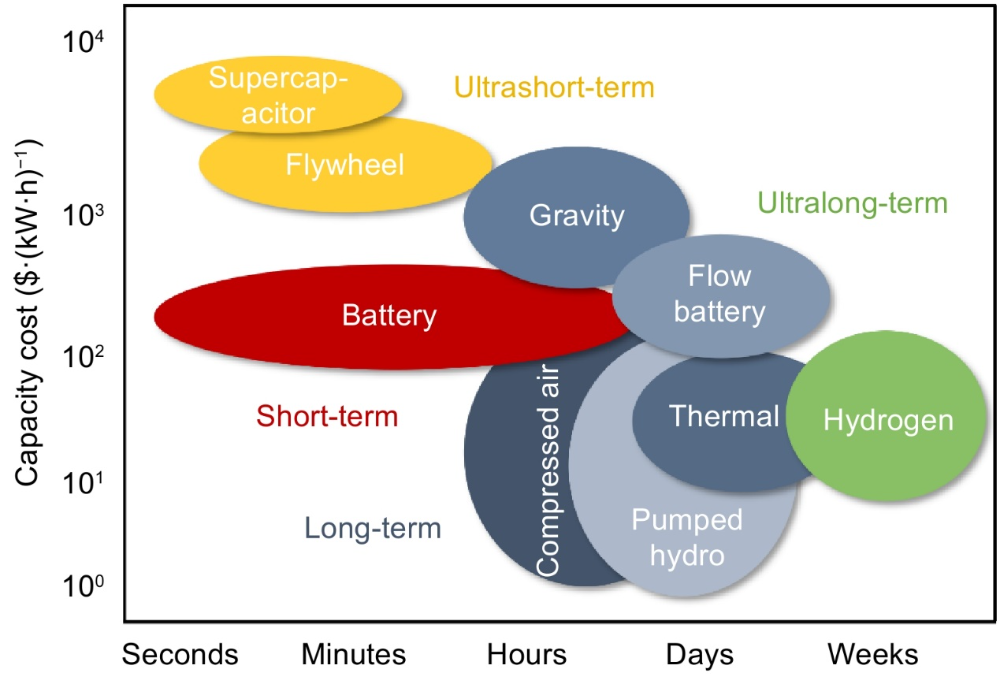
Figure: Comparison of different electrical energy storage technologies (Source: Figure 1 of the original paper)
The article also systematically reviews the main challenges, cutting‑edge breakthroughs, and demonstration projects for each electrical energy storage technology.
The Key Role of Levelized Cost of Storage (LCOS)
The article emphasizes the importance of the levelized cost of storage (LCOS) in predicting market changes and guiding policy investment. Citing a study on energy storage technology costs, the article notes that the costs of various storage technologies are projected to fall by about one‑third by 2030 and about one‑half by 2050. After 2030, lithium‑ion batteries are expected to be the most economically viable option for virtually all stationary applications; investing in other battery types may be futile unless these technologies achieve significant performance improvements. Another study indicates that by 2035, lithium‑ion batteries will extend their storage duration into the 10‑hour range, while hydrogen storage will penetrate down to the 48‑hour range.
Region‑Specific Storage Development Pathways
The article points out that different regions should choose differentiated energy storage development pathways based on local renewable resource endowments and economic needs:
Northeast China: Combined heat and power storage, suitable for cold climates;
North China (including Inner Mongolia): Large‑scale wind and solar + hydrogen storage;
East and South China: Customer‑side storage and ultra‑short‑duration regulation as primary focus;
Southwest and Central China: Leveraging hydropower advantages, primarily pumped hydro storage;
Northwest China: Dual advantages of wind/solar resources + lithium resources, comprehensive development of both short‑duration and ultra‑long‑duration storage.
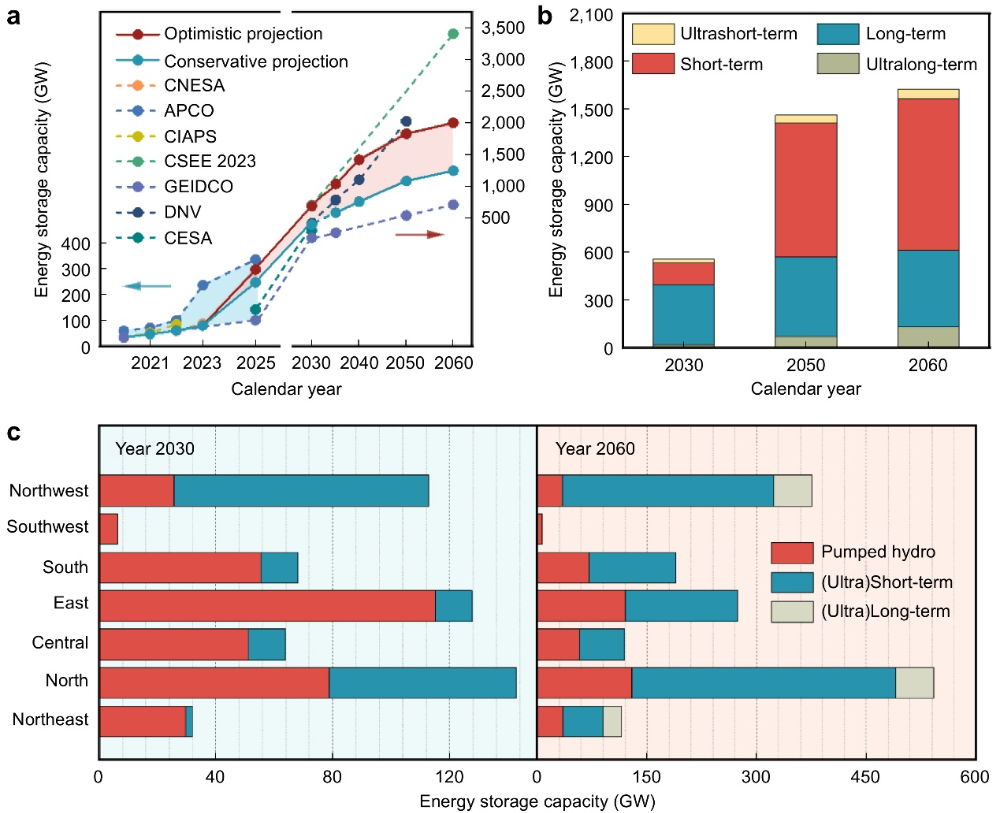
Figure: Installed capacity projections for energy storage in 2030 and 2060 (Source: Figure 5 of the original paper)
Policy Recommendations: Four Levers to Drive Storage Expansion
The article proposes multi‑sectoral coordinated policy recommendations:
R&D incentives: Prioritize support for frontier technologies such as solid‑state batteries, flow batteries, compressed air energy storage, and hydrogen storage;
Grid integration rules: Establish unified grid connection standards, compensation mechanisms, and safety regulations for energy storage;
Economic incentives: Tax credits, low‑interest loans, discharge subsidies for energy storage, etc., to attract social capital;
Talent training: Strengthen specialized energy storage training programs in universities, vocational schools, and online platforms;
Regional customization: Encourage local governments to select appropriate technology pathways based on their resource endowments.
Citation: Liu J N, Huang W Z, Tang C, et al. The shifting technology landscape of electrical energy storage toward carbon neutrality in China. Technology Review for Carbon Neutrality, 2025, 1: 9550004. https://doi.org/10.26599/TRCN.2025.9550004
Corresponding Author Biography
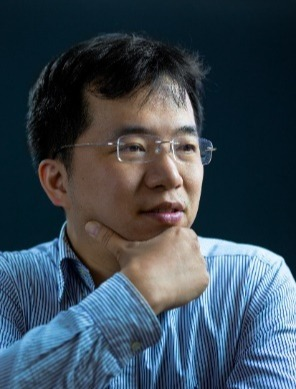
Zhang Qiang is the Chair of the Department of Chemical Engineering, Tsinghua University, a tenured professor, and doctoral supervisor. He has received the National Science Fund for Distinguished Young Scholars, the Xplorer Prize, the Young Scientist Award for Sustainable Development, and the Tian Zhaowu Award from the International Conference on Electrochemistry. From 2017 to 2024, he has been consecutively named a "Highly Cited Researcher" by Clarivate Analytics. Professor Zhang Qiang's research group has long focused on energy chemistry and energy materials, with particular emphasis on the principles of lithium‑sulfur batteries, lithium metal batteries, and solid‑state batteries. The group has developed a variety of high‑performance energy materials, including composite lithium metal anodes, carbon‑sulfur composite cathodes, lithium‑rich manganese cathodes, and halide electrolytes, and has constructed high‑energy‑density lithium battery devices.
Zhang Qiang Group website: https://www.qianggroup.com/


 Latest recommendations